Why Germany’s Mensa Managers Serve What They Serve
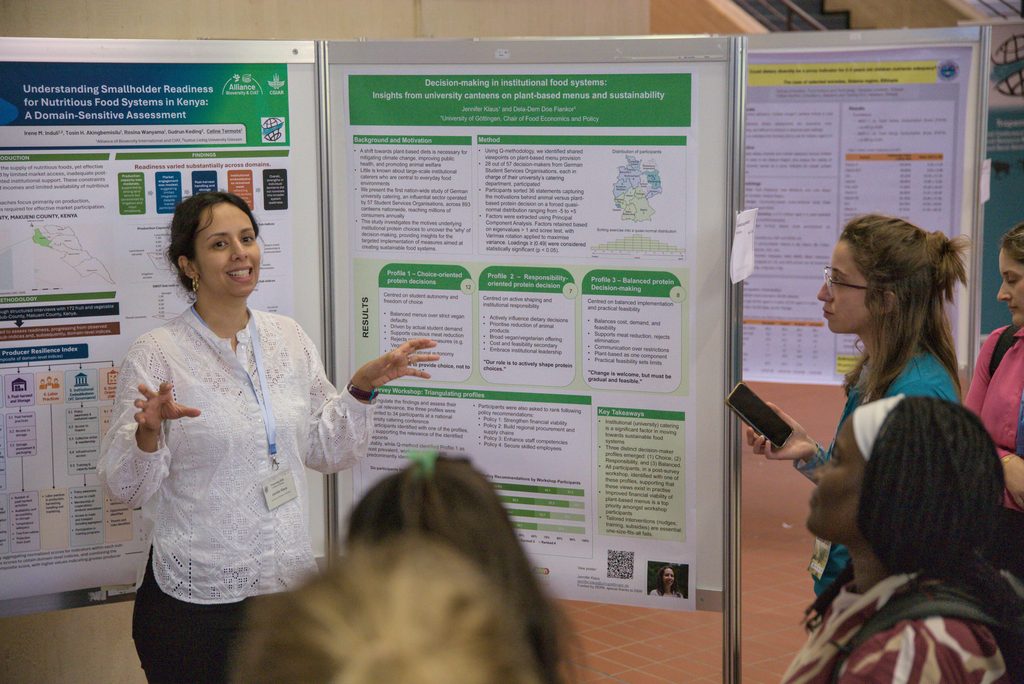
Jennifer Klaus presented a poster based on her PhD work in Tropentag 2026. Photo credits: Julius Nickl
Every day, Germany’s university canteens serve thousands of meals, but little research has examined how menu decisions are made. Across the country, 57 Student Services Organisations (Studierendenwerke) manage 893 canteens, yet we know little about how managers choose between animal-based and plant-based proteins. At Tropentag, Jennifer Klaus from the University of Göttingen’s Chair of Food Economics and Policy presented the first nationwide study on this topic, co-authored with Dela-Dem Doe Fiankor.
Understanding why canteen managers make certain choices is the first step to making menus more sustainable. Klaus notes that “empirical evidence suggests more plant-based diets are needed to help fight climate change, improve public health, and support animal welfare”. This is especially supported in developed countries, where meat consumption is high, and animals are usually grain-fed. Her research shows that managers have different perspectives, so a single policy is unlikely to work for everyone.
Klaus used Q methodology, which mixes qualitative and quantitative analysis, to study managers’ motivations behind protein provision choices. She asked them to sort 36 statements on a scale from -5 to +5. Out of 57 organisations invited, 28 participated. Their answers were then grouped into shared viewpoints using statistical analysis.
She gathered three profiles:
• Choice-oriented protein decisions (12 people): Manager belonging to this profile perceive student’s autonomy of choice to be the most important factor. They rather provide students with a variety of options rather than deciding what they eat. They favour balanced menus based on student demand, support a gradual reduction in meat consumption, and do not back strict measures such as Veggie Days.
• Responsibility-oriented protein decisions (7 people): They believe that they have a social responsibility to promote plant-based foods. They aim to guide students in forming their eating habits by providing fewer animal products and more vegan and vegetarian options; for them, cost and practicality are important but factor in less than their social responsibility.
• Balanced protein decision making (8 people): These managers agree that meat consumption should be reduced but not eliminated altogether. They think it is better to promote change through communication than by introducing rules, and they believe the changes should be realistic.
To test the results in practice, the profiles were presented recently at a national conference of university catering managers. In a workshop 34 participants were asked if they feel represented by these profiles. While the survey showed that most managers were choice-oriented, the majority (52.9%) of workshop participants related more to the third, balanced profile. Workshop participants were also shown policy recommendations based on the results and asked to them according to importance. 63.6% of participants said making plant-based menus financially viable was most important, ahead of creating regional procurement and supply chains, staff training, and securing skilled employees.
Canteens have to follow public-sector rules, so they have less flexibility than, for example, supermarket managers. Klaus says this “is why solutions like nudges, training, or subsidies should be adapted to each type of manager”.
This article was written by Sofía De León Guedes