Not Just Meat and Milk: How African Women and Pastoralism Are Protecting Endangered Drylands
Serena Ferrari, a socio-economist at CIRAD (Agriculture Research for Sustainable Development) and a PhD from the Université libre de Bruxelles based in Addis Ababa, Ethiopia, offered insights into how pastoralist farmers play a crucial role in conserving pasture ecosystems and providing livelihoods for people in Africa, especially women.
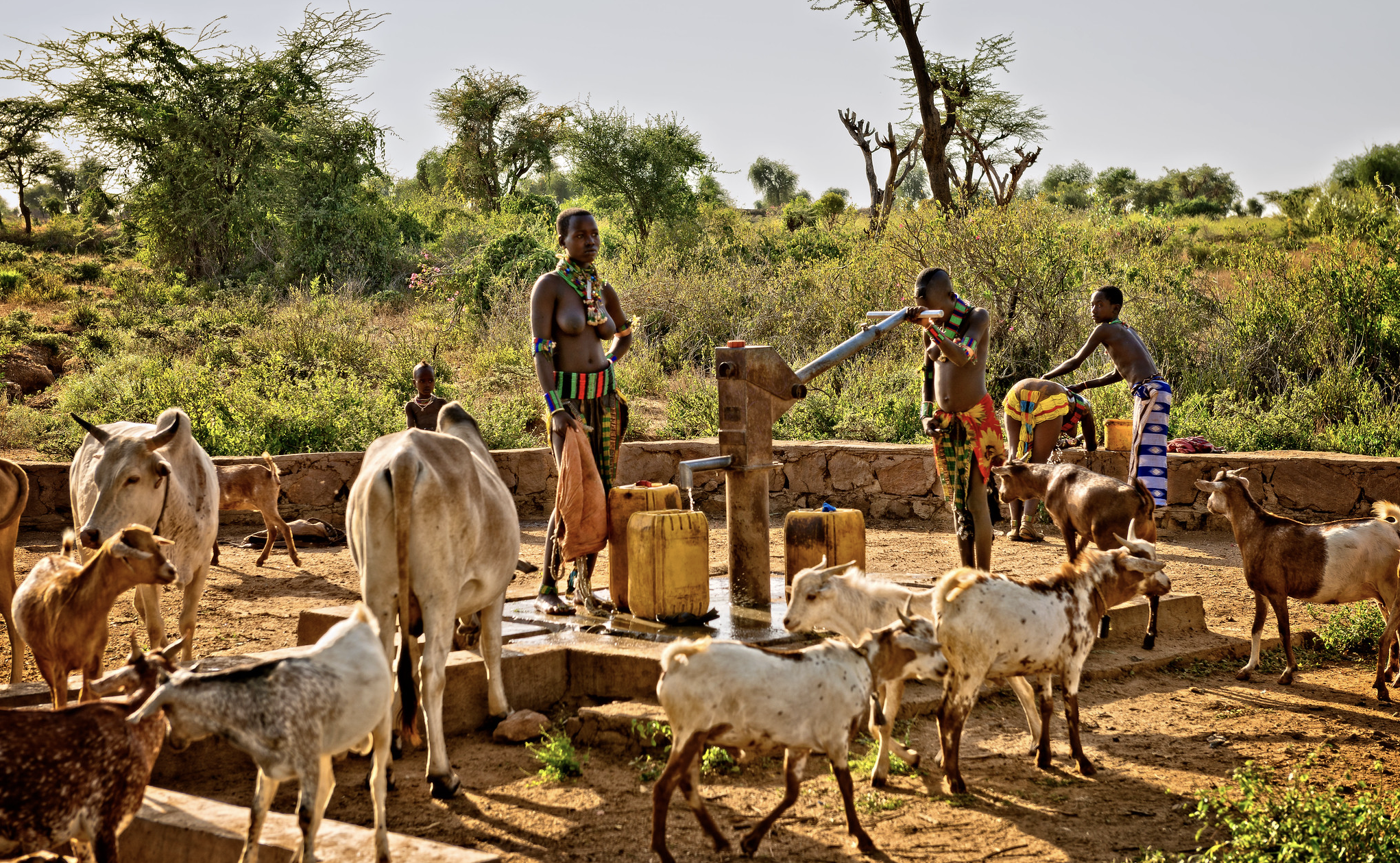
Hamar women getting water from water well, Turmi, Ethiopia. Photo credit: CamelKW/Flickr
Pastoralism in Africa
In the drylands of Africa women take on much of the work associated with pastoralism. They look after milk production and small ruminants. In eastern Ethiopia some act as traders, going from village to village to collect up to 30 animals for sale in urban markets. Livestock also provides employment for the whole community, with levels reaching 90% among pastoralists in Kenya’s drylands. The pastures rely on the herds because if the land is not grazed it quickly becomes overgrown with shrubs and tall grasses.
Ferrari’s main point was that pastoralism is not merely a chain of production involving meat, milk, or animal skins. It also carries out production, social, environmental and local development functions at the same time, which are interrelated. Drawing on the concept of multifunctionality developed for agriculture in the 1990s, she said support that focuses on only one function is likely to undervalue pastoralism’s true worth.
Based on more than ten years of experience in Senegal and Ethiopia, Ferrari described how pastoralists achieve a fairly stable output with low inputs in highly variable environments. They do this by moving in response to water and pasture availability, mixing different species and breeds, and combining livestock with crops, usually cooperating with nearby farmers. Pastoralists provide up to 90% of the meat consumed in East Africa and 70% of the milk consumed in Tanzania. The system is not static, as herders move their camps close to markets, helping establish value chains.
Ecosystem services and social functions
Grazing helps keep the landscape available for others to use. Animals act as a “biological pump” by concentrating nutrients in night enclosures, where they later become suitable for cultivation. Cows can disperse seeds over distances up to 100 km. Pastoral systems generally produce less methane than intensive systems, and rangelands mostly managed by pastoralists may contain about 30% of the world’s soil carbon. Ferrari emphasized evaluating emissions at a landscape level. According to CIRAD studies, dryland systems can achieve a balanced carbon budget when carbon sequestration by grasses, trees, and manure is considered along with emissions from digestion, wildfires and water pumps.
A meat value chain in the Somali region of Ethiopia included women at almost every stage. Traditional safety nets enabled poorer households to borrow animals in order to obtain milk and calves, and livestock plays a central role in weddings, births and funerals.
Challenges and perspectives
The wider cultivation expands, the more grazing land pastoralists lose and some of them may be attracted to armed groups. Their contribution is also not fully recorded. In Chad, official figures show pastoralism accounting for 11% of GDP and 24% of agricultural GDP; when self-consumption is taken into account, the amount of household income amounting to about one third across all income groups rises the figures to 27% and 61%.
The community is holding meetings to map transhumance routes and access to pastures and water points, and communicating decisions through local leaders and community radio to avoid land-use conflicts. A comparative study carried out in Argentina, Chad, and Mongolia is helping improve how the economic value of pastoralism is assessed. Contrary to the widely held belief that herders rely on aid, the study found that when droughts or recessions occur, households generally resort to their own livestock-related strategies such as moving farther away and more frequently, selling more animals, or depending on family migration. Ferrari stated that support should work in cooperation with pastoral mobility.
This article was written by Sofía De León Guedes