
Feeding Food Waste to Cattle in the Global South: Can AI/Machine Learning Make It Safe?
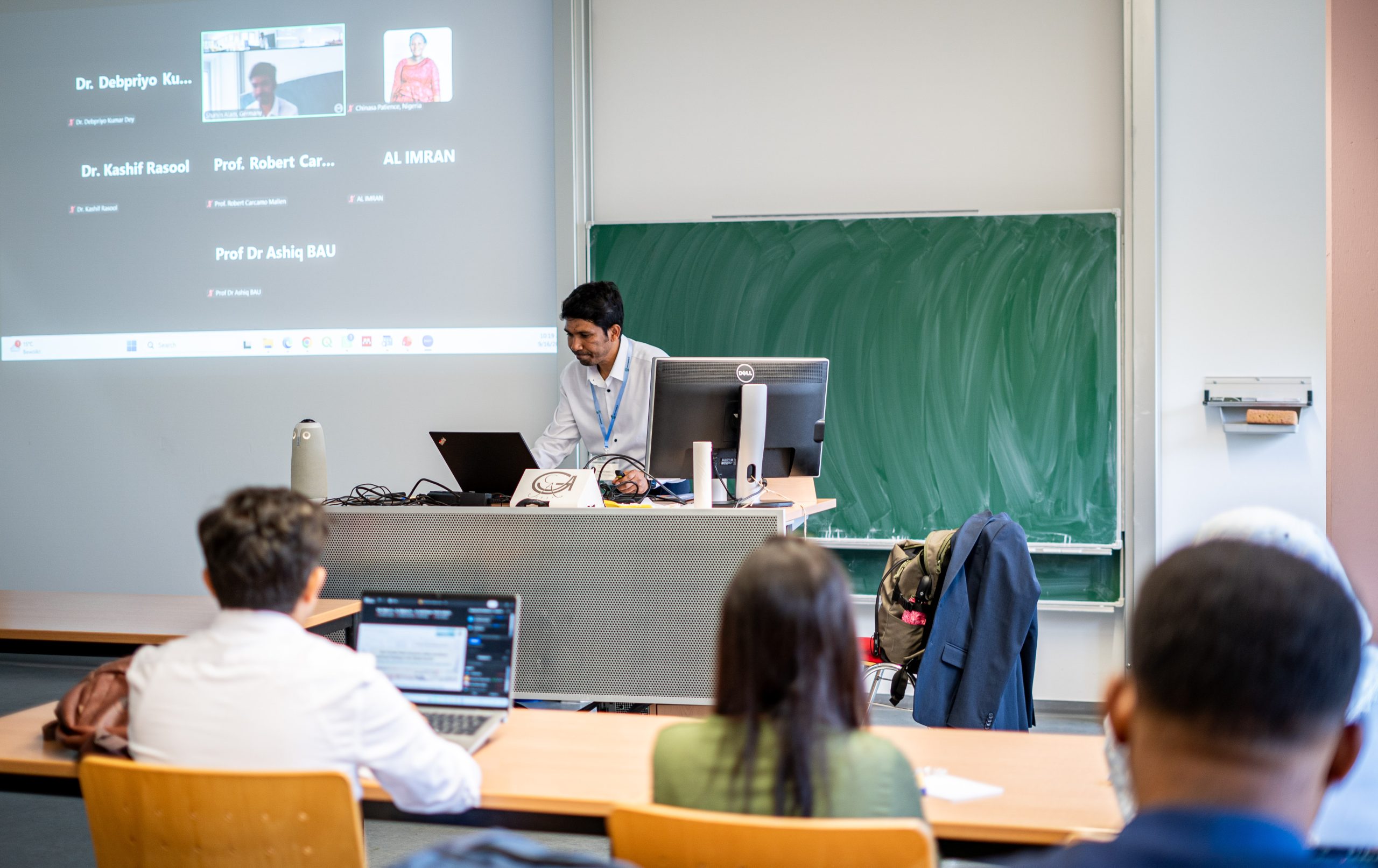
Photo taken by Adesoji Adeyemi-Adejolu
Picture yourself at the edge of a wet market in a Bangladeshi and India city as the evening approaches. Next to each other are stacks of bruised tomatoes, banana skins, and unused rice, along with plastic bags and scrap metal. Across the Global South, large quantities of unwanted food decay every day.
Suppose there were a machine to turn this waste into something useful, such as meat or milk! Oops. We already have one. It’s called ruminants.
Researchers use the term circular food resources (CFR) for food that people can no longer eat but is still useful as animal feed. This includes extra crops that farmers cannot sell, by-products like banana peels, produce thrown out by supermarkets, and leftovers from restaurants or homes. Ruminants animals like cattle, buffalo, sheep, and goats are especially good at eating this kind of mixed, fibrous food, much better than pigs or chickens.
During a workshop at Tropentag 2026 at the University of Göttingen, people from Bangladesh, India, Nigeria, Pakistan, and Qatar shared similar stories. In Bangladesh, family dairies with limited feed use kitchen scraps, and cows in cities look for food around markets. In India, farmers often use pineapple silage and eggshells as supplements. Most of these practices are informal and not regulated.
Food waste
In many parts of the Global South, food waste is mixed with plastics and metals, and there is no testing of what animals eat. One study in South Asia found that when food waste made up about half of the cows’ diet, they produced more milk and healthier fatty acids. However, the feed also had higher levels of heavy metals. Most of the milk was still safe because cows got rid of the metals in their dung, but that dung can return the metals to the fields as manure. Microplastics are still a big question.
Sorting waste by hand takes a lot of time and can be risky. Hyperspectral imaging, used with machine learning, could help automate this process. These special cameras capture hundreds of wavelengths for each pixel, which helps reveal what nutrients/chemicals are present. An animal scientistsaid the technology can show what is in the material and where each part is so that it can spot things like mould or plastics in a mixed pile.
Start-ups in India, Korea, China, and Thailand are already turning food waste into animal feed, though the methods regularly use a lot of energy. In India, a government-backed study is looking at how food waste can be used as feed in both rural and urban areas. Companies already use near-infrared technology to sort materials on conveyor belts.
Still a way to go!
Current imaging models were designed for foods that look the same, like potatoes or beans, not for mixed waste like fish, peels, and melon rinds. The equipment also costs a lot, so some suggest creating shared centers funded by governments or private investors. An Indian animal scientist pointed out, farmers always want to know if it is profitable. Any solution needs to work for small farms, not just big factories.
Cows already take care of part of the problem. Now, the big question for researchers in the Global South is whether AI can help with the rest by showing that the feed, milk, and meat are safe. Dr. Shahin Alam, the workshop organiser, concluded by highlighting this as a promising direction for future research.
This article was written by the one of the Global Landscapes Forum Student Reporter, Sofía De León Guedes.
Thank you, Sofía De León Guedes, for capturing all the key information so well in your write-up.