Nour El Houda Amhez: When Livelihood Diversification Becomes Survival
Behind every percentage in Nour El Houda Amhez’s research is a household trying to make a living.
Her PhD research follows settled Bedouin communities in northern and eastern Lebanon, where traditional livelihoods are changing under the pressure of economic hardship, limited opportunities and repeated crises. Her work asks not only what people do to earn an income, but what happens when the ways they once made a living are no longer enough.
A PhD researcher in Animal Husbandry in the Tropics and Subtropics at the University of Kassel, Nour is also a licensed dietitian. Her research sits at the intersection of food security, rural livelihoods, livestock systems and nutrition, with a particular interest in communities living through economic and political uncertainty.
At Tropentag 2026, she presented part of her PhD research through her poster, “Beyond Pastoralism: Survival-led Livelihood Diversification among Bedouin Households in Rural Lebanon.” The study draws on a household survey of 361 Bedouin households, representing 2,152 people, across northern and eastern Lebanon.
The picture that emerges is one of adaptation— but not necessarily by choice.
Around 70% of the surveyed households were not involved in agrarian activities. Instead, families combined different sources of income, including wage labour, private-sector employment, self-employment, public-sector work and remittances.
At first glance, livelihood diversification might sound like flexibility or opportunity. But Nour sees something more complicated behind the numbers.
“I describe much of the livelihood diversification observed in the study as survival-led rather than opportunity-led.”
For households facing rising costs, limited employment opportunities and a prolonged economic crisis, having several sources of income does not necessarily mean having more security. Sometimes, it simply means having to find another way when the previous way is no longer enough.
The economic pressures are stark. Nearly half of the surveyed households reported monthly incomes below USD 300, while almost four in five were in debt. Among households keeping livestock or growing crops, agriculture remained an important source of income, even as families relied on other forms of work to make ends meet.
Access to land and other productive resources was another challenge. In eastern Lebanon, livestock-keeping households depended heavily on rented pasture, while crop farmers relied almost entirely on rented land.
For Nour, these findings are not simply statistics about income, land or employment. They are indicators of the choices people have— and the choices they do not have.
Beyond the numbers
Her research also looks at what happens beyond the livelihood question.
Another part of her PhD examines food security and nutrition, using indicators such as the Food Insecurity Experience Scale, Household Dietary Diversity Score and Food Consumption Score, together with anthropometric measurements of children.
These different pieces allow Nour to connect livelihoods with something much more fundamental: whether families can access enough nutritious food, and what prolonged hardship means for their well-being.
One question lies at the centre of her work: how do prolonged crises change not only the way households earn money, but also their access to food, agricultural resources and future opportunities?
For Nour, answering that question requires looking at people as more than data points.
“Especially when working with vulnerable or marginalized communities, research should not reduce people to numbers or indicators. Statistical analysis is important, but understanding the history, constraints, choices, and lived experiences behind those numbers is equally important.”
That connection between numbers and lived experience is also what Nour hopes to carry forward in her research.
A poster, a conversation and a moment of recognition
At Tropentag 2026, Nour’s work received the Best Poster Award.
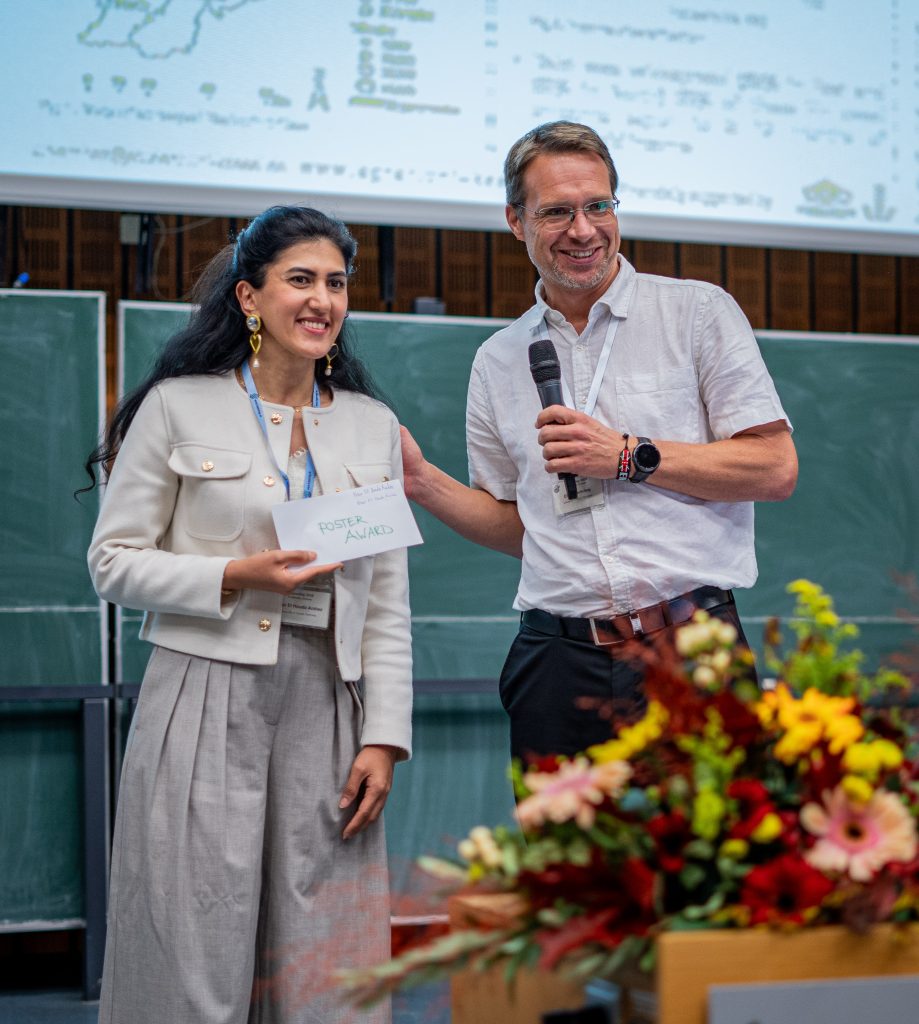
Nour El Houda Amhez receiving her Poster Presentation Award at Tropentag 2026. (Photo: Adesoji Adeyemi-Adejolu)
For her, the recognition was meaningful— but so were the conversations that came with it.
Tropentag brought together researchers working on livestock systems, food security, rural development, pastoralism and other areas connected to her work. Discussing her research with people from different backgrounds helped her see how the experience of Bedouin households in Lebanon connects to wider questions about changing rural livelihoods.
She also appreciated the less formal moments of the conference— conversations between researchers at different stages of their careers, discussions around posters, and the opportunity to explain her work to people outside her immediate research area.
Sometimes, she says, one simple question from another researcher can make you rethink an entire section of a paper.
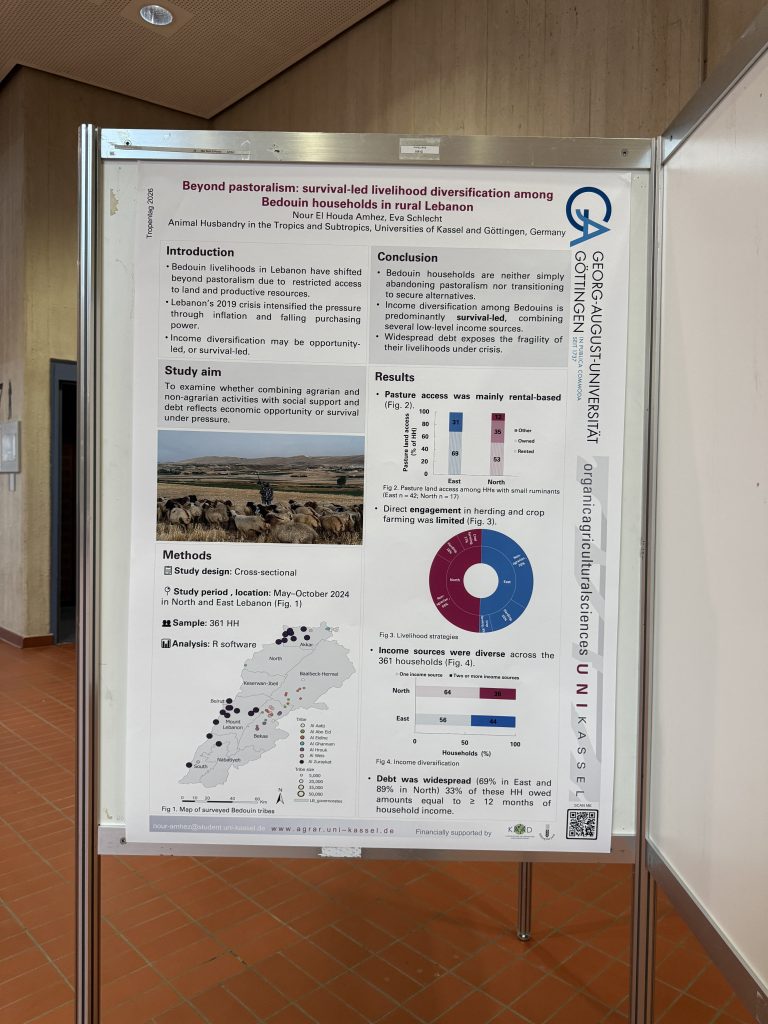
Nour El Houda Amhez’s award-winning poster at Tropentag 2026. (Photo courtesy of Nour El Houda Amhez)
Research that stays connected to people
Nour’s PhD research is still unfolding. A systematic review examining livelihood transitions and food security among pastoralist communities in the Levant and East Africa has already been submitted. A second paper, based on the socio-economic and livelihood findings presented at Tropentag, is being prepared, alongside a third paper focusing more closely on food security and nutritional outcomes.
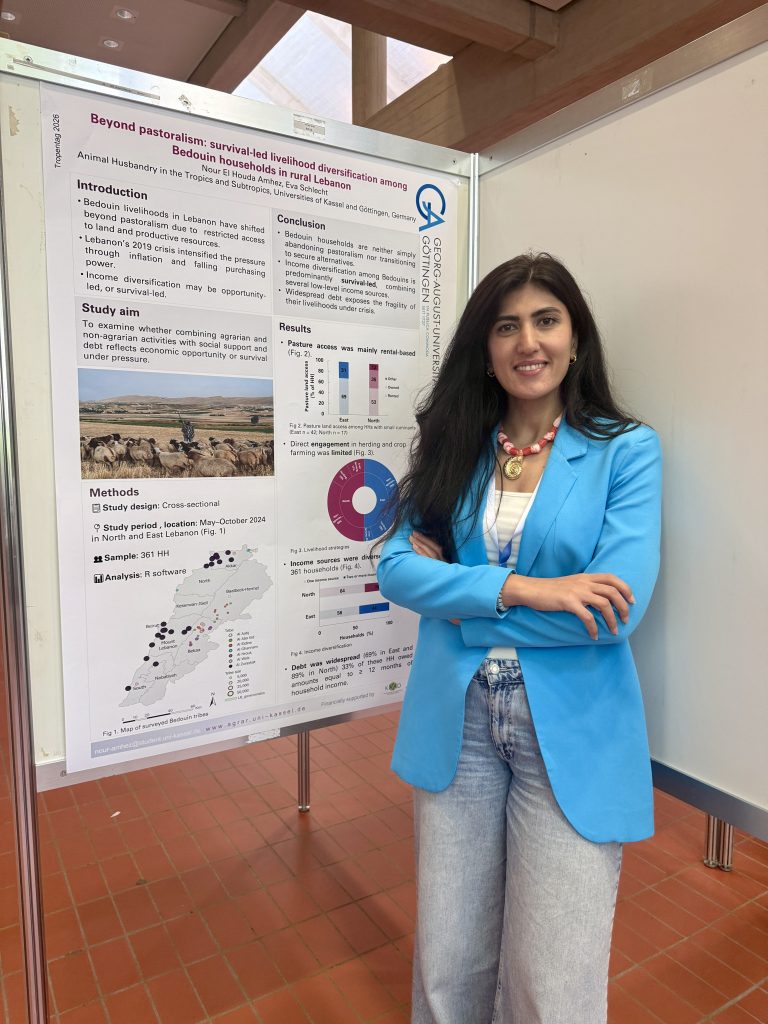
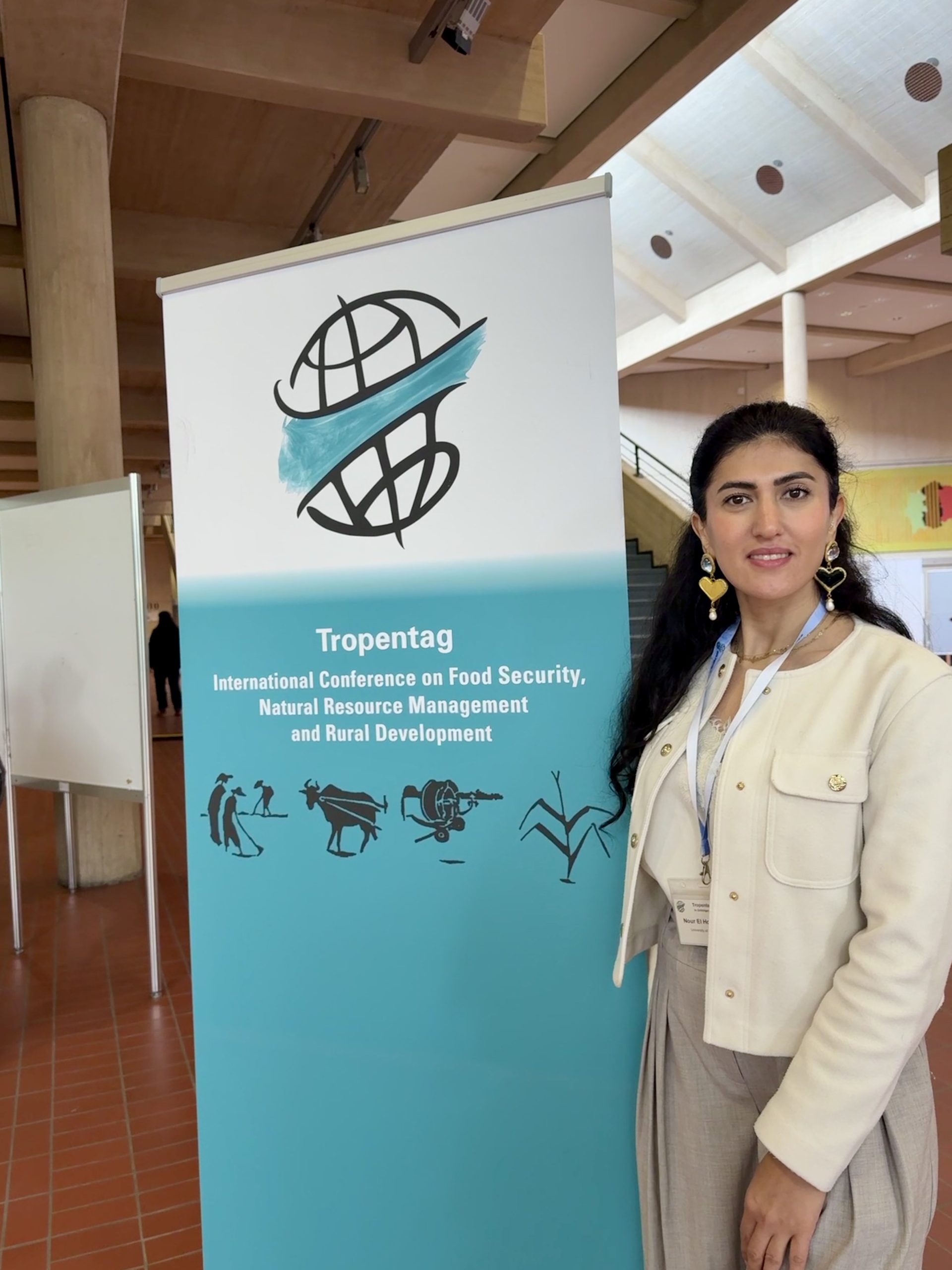
Nour El Houda Amhez pictured next to her poster at Tropentag 2026. (Photo courtesy of Nour El Houda Amhez)
Looking ahead, Nour hopes to continue working on food security, nutrition, rural livelihoods and agri-food systems, particularly among communities affected by conflict, economic crises, displacement and long-term marginalisation.
Her advice to young researchers comes from experience: research rarely moves in a straight line.
Fieldwork changes. Plans are delayed. Methods have to be adapted. Papers take longer than expected. Presentations do not always go as planned.
“These moments can feel discouraging,” she says, “but they are also part of becoming a researcher.”
She also encourages young researchers to talk about their work— even when it feels unfinished.
Because sometimes, a conversation can change the way you see your own research.
And sometimes, behind a number, a graph or a statistical result, there is a much bigger story waiting to be heard.
For Nour, that is what makes research matter.
“Research should not reduce people to numbers or indicators.”
Her work is, ultimately, an effort to keep those numbers connected to the people behind them— their livelihoods, their choices, their constraints, and their hopes for what comes next.