We Interviewed The Man Who Checks Whether Research for Development Changes Anything
The Evaluator dialogued with Tropentag Student Reporters about what makes research organisations have high impact on real change sustainability shifts.
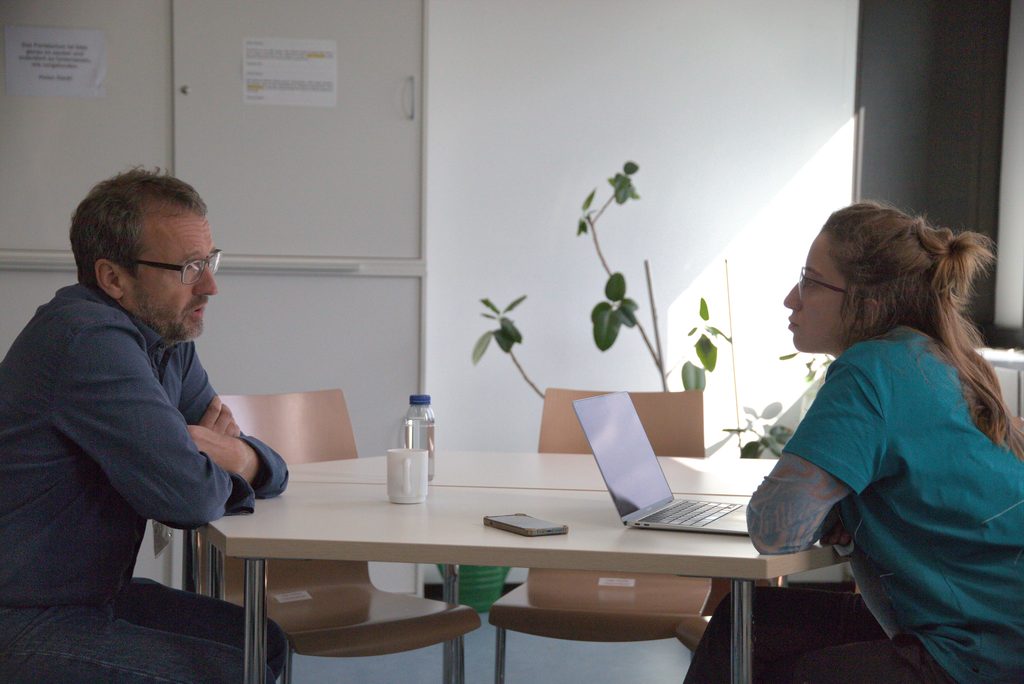
Photo taken by Student Reporter Julius Nickl
Walk through research organisations’ networking environments, and you will hear a lot about research that aims to change lives: better crops, healthier soils, more resilient food systems. Markus Palenberg is the person who comes in later and asks whether it did.
He has a quick test for spotting the organisations that probably won’t. Listen to how they talk.
He says organisations around the world say things like, “We catalyse multidimensional innovation ecosystem spaces, and we leverage everybody’s stakeholder,” offering an example. “It’s nonsense. But you have a lot of that.” He is proud to see some of Tropentag partners he worked with do a great job, and that brought him here.
Palenberg runs the Institute for Development Strategy, a small evaluation company based in Munich. He has evaluated several programmes in international development, many of them for CGIAR, the global agricultural research partnership. He has also seen those programmes from the inside. He trained as a physicist and now works independently, which gives him “a logical approach”.
That outside view is exactly why he is worth hearing at a conference like this one. Most people at Tropentag design, run or study research for development. Palenberg’s job is to judge whether that research is relevant, effective and efficient, and whether it will leave anything behind once the funding ends. The questions he asks are the ones every project here will eventually face.
His verdict on grand promises is that “A good organisation also does real work,” he says. “It may have a PR department, or even scientists who can sell it well, but without bending things too much. But then you have those who live only in that grandiose world. And there’s a big risk that they don’t achieve any impact or make any difference. Because the plans they have are so great and grandiose that actually nothing moves with the resources and the capacities they have.”
We sat down with him during Tropentag to talk about what an evaluator really looks for, why international research centres can end up draining the talent they are meant to build, what young scientists should look for in an employer, and why the most transformative change in agricultural research was built from small steps.
What an evaluator does
Markus, you’re an evaluator, and you’ve been evaluating CGIAR. How and when did that start?
I conduct programme evaluations in international development. CGIAR has been a client a couple of times, different centres in the system.
It started, I think, in 2006 or 2007. CGIAR had programmes called Challenge Programmes, and they were looking for somebody to evaluate a couple of them, focusing on governance and strategy across different programmes. I had no clue about CGIAR back then, of course. But I always liked it a lot, because I’m a scientist by training as well, in a totally different field, physics. So I really relate to that environment of scientists doing research for development.
After that, I did a lot of smaller assignments for the system office, which was called something different back then, learning how to set up independent programmes across different centres. For two of the three programmes I had evaluated, they called me in as a consultant some years later. For one of them, I was on the board for four years. For the other one, rs, I was in the executive management for about four years, working on strategy for the programme. After that, I did some other evaluations.
Why is an evaluator important for organisations to achieve sustainability goals?
Good question. Most of the money and resources we have are tax dollars. This is really public money, from people, for a certain purpose. So the organisations that give the money to implement projects want some independent check. One part is whether the money is spent and doesn’t just disappear. That’s an audit: a financial audit or performance audit.
And then there is evaluation. It looks at whether the programme or project is doing something relevant. Is it effective? Is it efficient? Can any improvement be made? That’s the work evaluators do, and they need to be independent of the programme, so they have an objective, unbiased view and can write things down. Very often it’s the board of a programme that commissions an evaluation and receives it, and then management reacts to it. But management is not the boss in the evaluation process.
The tensions at the heart of research for development
What are the main challenges for these organisations right now?
That’s a big question. For organisations working in agriculture and sustainability, I know the CGIAR centres quite well, and I think they have to manage a couple of tensions.
They are set up to advance development objectives and research for development, and one of the ideas is that they make themselves redundant. You want to strengthen capacities in developing countries, strengthen research for development there. On the other hand, you have an institution with staff and a director general, and they want to grow the institution, to have a healthy institution. So that’s a tension in a way.
In concrete terms, this means that if you hire a scientist, you might hire them away from the developing country’s system. So instead of strengthening it, you take something away.
So organisations are taking the brains, the best people?
It’s contradictory. There are international careers and so forth. CGIAR does a lot of work to actually strengthen these systems, but it’s not really clearly its mandate. So that’s one tension.
Coming back to brain drain and the challenges institutions like CGIAR face in becoming high-impact institutions for research for development.
They have a couple of tensions. There’s this tension of making part of their work redundant by strengthening the capacities of country partners so much that you don’t need an international research centre anymore. Crop breeding is a big example.
And then there are other tensions. There are the long-term objectives CGIAR has, and the goals get broader and broader. Now it’s systems science, looking at whole food, land and water systems. So it’s a big, big goal. At the same time, the way this is financed is very often short-term projects. How to manage that is another tension. You have a goal you will maybe achieve in 10, 15, 20 years, and a donor that gives you money for two years or maybe five; then the results are reported, and you’re done with it. And we don’t live in times of people being patient lately. People want everything right now.
So CGIAR has to manage all kinds of things. It has been through a couple of big reform cycles. And as an evaluator, you are very often called in during a programme or at the end of it. Then it’s very hard to establish what development impacts the programme has contributed to, because they haven’t materialised yet. So you use theory-based approaches: all the conditions are there, I see initial change, so I can extrapolate that something will likely happen. It’s difficult to do. Ideally, you would come in 20 years later and really learn what your initiative has done or not.
Where CGIAR gets it right
What is CGIAR’s main strength?
It’s a research-for-development organisation, so it doesn’t do blue-sky research. It always has a mandate to do relevant things, in the sense that it will improve people’s lives worldwide. That’s a very nice thing, and they’re really good at it.
You have a lot of fantastic people. I led a large evaluation of capacity development at CGIAR in 2016 and 2017, and I met people who, without it being visible, mentored young scientists from the Global South alongside their regular work. That investment changed their lives forever. It’s a bit like a great university professor who changes a young academic’s life and puts them on a different trajectory.
What would you advise a young scientist picking an organisation to work with?
Something you have a passion for in terms of topic. And then find a good mentor, somebody who will actually care to develop you. That’s really crucial. Of course, you never know that beforehand, but you can see some signs.
In terms of organisation, I would personally pick one that is not too hierarchical. Not one that says, “I don’t listen to you because you have to be here for ten years until I take you seriously,” but rather one that sees talent and good ideas right away. But the most important thing is to pick something you are really passionate about. The rest usually follows.
Tropentag from outside academia
How do you see this conference, as someone from outside academia? Could it be fertile ground for collaboration?
It just started. Yesterday we had a networking event where we met, and I think that was helpful. A lot happens in informal interactions, learning in the corridor over a coffee. A lot of learning doesn’t happen by reading a report. It is learning by doing, seeing something, and sharing tacit knowledge that isn’t written down. So I think it’s certainly fertile ground for that.
I’m personally a little worried about the very broad approaches that are preached. It’s very important to have a holistic view, and everything is interconnected. But if you have a small research grant, or a limited scope at your institution, you can’t always convene all stakeholders and do the big-picture thing. Very often it boils down to having a good overview and then picking something in a complex system that can actually make a difference. Being smart about where the low-hanging fruit is, where you can do something with your skill set that really changes something for the better.
The case for small steps
Palenberg then came back to the grandiose talk, and to a word used earlier in the interview: transformative.
“The biggest achievement of CGIAR is the Green Revolution, which was certainly transformative. But the research activities were all incremental. Breeding plants that gave a higher yield, had more resistance, were better adapted to the environment, all incremental stuff.
“So it doesn’t always have to be the change-everything-completely approach. There are a lot of small-step improvements that are really worthwhile. And with project-level, short-term funding, projectisation and so forth, these are often much more realistic to achieve.
“In German, we say ‘der Spatz in der Hand ist besser als die Taube auf dem Dach’: the sparrow in the hand is better than the pigeon on the roof. Better to have a small result that you actually have, that’s there, than to talk about the big one and never get it.”
What do you expect to take home from this conference as a professional?
This kind of inspiration: a lot of people interested in similar things, trying to impact the world, hopefully for the better, and doing their best, and just seeing that other people are around. When I’m back in Munich, I’m not surrounded by people like that. So you feel part of a cool community. It gives me a lot of energy for my work.
This interview was conducted by one of the Student Reporters, Sofía De León Guedes.