Is Overgrazing Really to Blame?
When a pasture looks dry and degraded, it may seem obvious what went wrong: too many animals grazing on too little land.
But in the semi-arid rangelands of Central Asia, the answer may not be so simple.
At Tropentag 2026, Khaytbay Artikov of the University of Kassel presented research from Uzbekistan that questions how pasture condition is assessed and whether changes in vegetation can always be linked to grazing.
His team developed a Pasture Condition Index (PCI) using field measurements of vegetation cover from 439 observations in Nurota District. They then used machine learning to examine which environmental and grazing-related factors best explained differences in pasture condition.
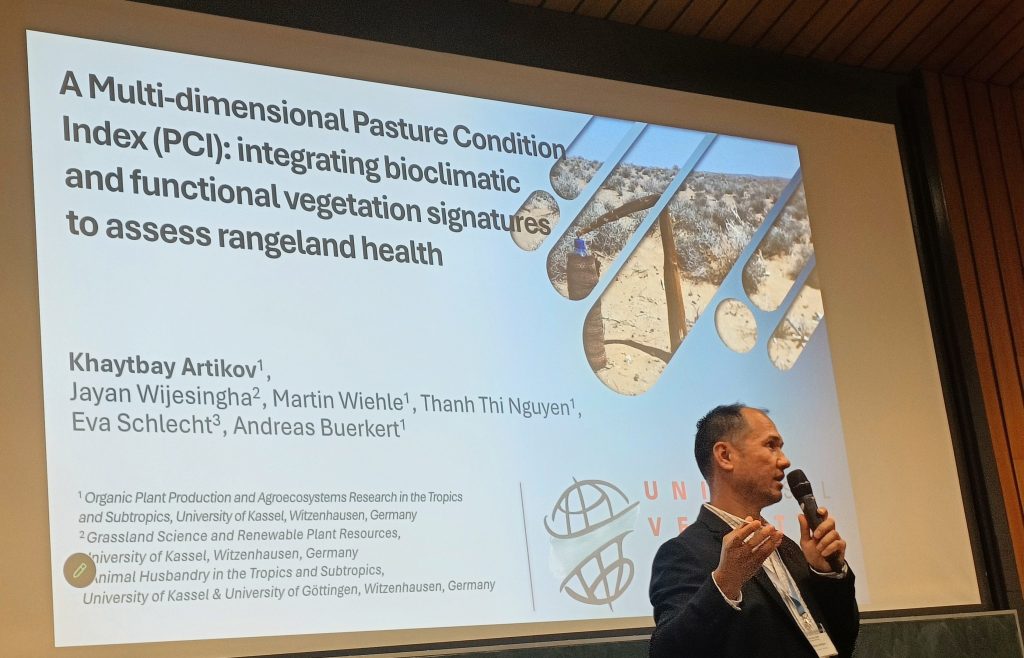
Khaytbay Artikov presents his research at Tropentag2026 (Photo: Swe Zin Moe)
The climate signal
The results pointed strongly towards one factor: water availability.
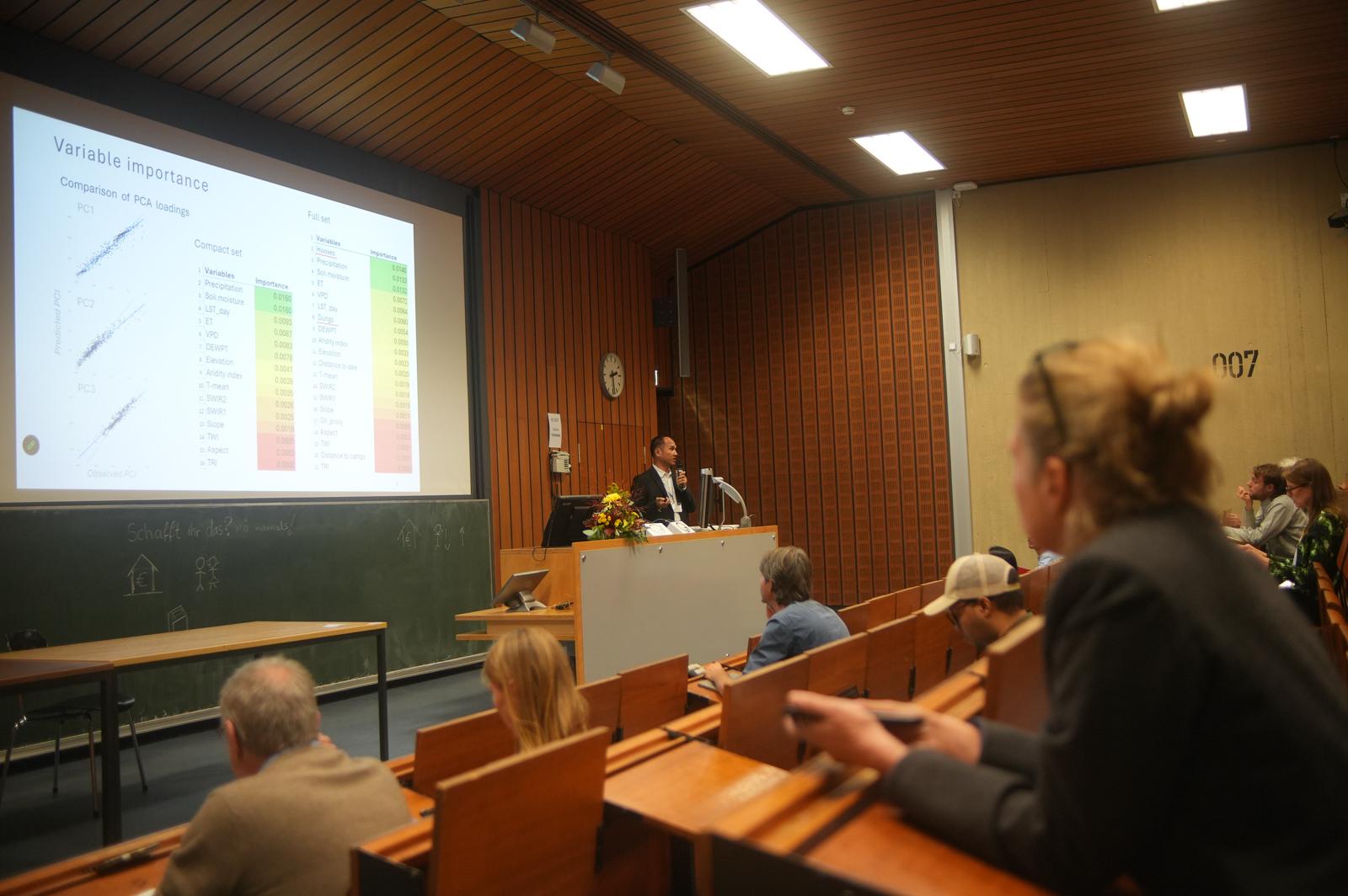
Precipitation, soil moisture and land surface temperature were among the main variables associated with pasture condition in the model. Together, these remote-sensing indicators provided a strong signal of how vegetation varied across Nurota’s dry landscape.
Grazing indicators also mattered. When field observations such as hoof marks, dung deposits, and distance from livestock camps were added to the model, hoof marks in particular became an important predictor.
But there was a catch.
The local signs of grazing were much harder to detect continuously using remote sensing than the broader climatic patterns.
That distinction matters because a pasture that appears degraded on a satellite image may be responding to a lack of moisture rather than grazing pressure alone.
A model with a warning
The researchers also tested whether their model could work beyond the locations where it was developed.
The results exposed a significant limitation. The full model initially showed a very high R² of 0.95, but its performance dropped to 0.58 when tested using spatial cross-validation— a decline of about 61 percent.
In other words, a model that performs extremely well in the places where it learned the relationships may not perform nearly as well somewhere else.
For a tool intended to support regional rangeland monitoring, that is an important warning.
Artikov and his colleagues therefore argue that the PCI needs further development before it can be used as a robust and replicable single indicator of rangeland health.
Looking beyond the grazing narrative
The study does not suggest that grazing has no effect on pastures. Instead, it highlights the difficulty of separating local grazing impacts from large-scale environmental variation.
In Nurota’s semi-arid environment, moisture availability appears to leave a particularly strong imprint on vegetation.
That could change how pasture degradation is interpreted. If climate-driven variation is mistaken for grazing damage, management responses may target the wrong problem.
For the researchers, the next challenge is to develop an index that can distinguish these overlapping signals more reliably— and eventually provide a clearer picture of what is happening on the ground across Central Asia’s rangelands.