From Price Takers to Price Givers: Does Cluster Farming Pay in Pakistan?
By Chidi Emenike
What happens when smallholder farmers stop working entirely on their own? Can working together help them produce more, reduce costs and negotiate better prices?
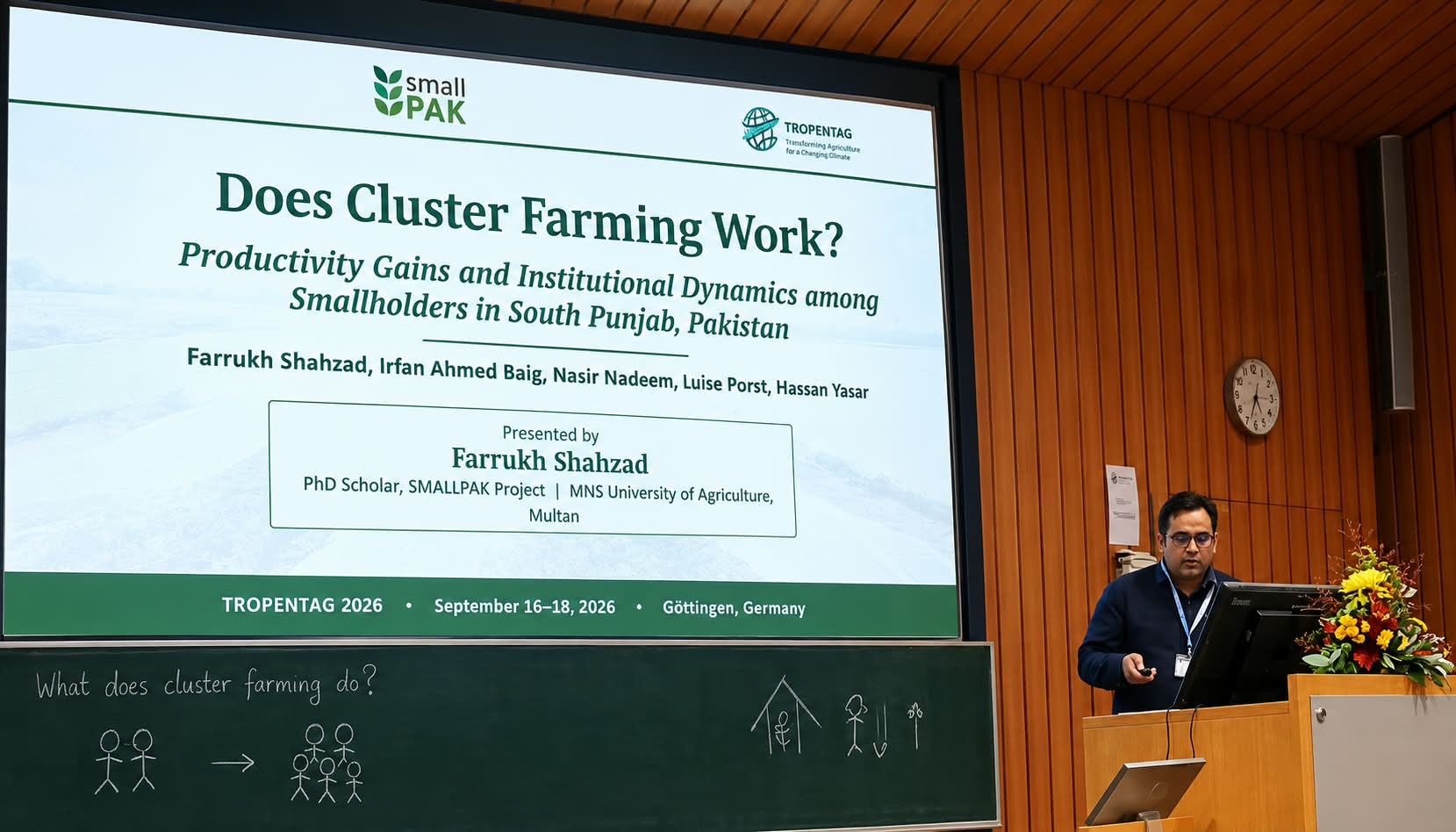
These were the questions behind Farrukh Shahzad’s presentation at the Tropentag 2026 conference in Göttingen, where he presented new evidence on cluster farming among vegetable farmers in South Punjab, Pakistan.
Shahzad, a PhD researcher at MNS University of Agriculture, Multan and part of the SMALLPAK project, studies cluster farming as a way of helping smallholder farmers overcome some of the disadvantages of farming and marketing individually.
For many smallholders, those disadvantages are substantial. Farms are small, production costs are high, markets can be difficult to access, and farmers often have limited bargaining power when they sell their produce. “In Pakistan around 95% of farmers are smallholders, mostly working on one or two acres,” Shahzad explains. So, collective approaches might make an important difference.
He described the pressure facing farmers in stark terms. Producing a crop such as wheat can require substantial upfront investment, with relatively lower returns, which can leave households struggling to cover costs and protect their livelihoods. Yet public agricultural support often focuses on individual inputs, such as fertiliser subsidies or machinery. Shahzad argues that farmers also need organisational solutions. “Cluster farming is a way step, a way to move ahead,” he says.
What does ‘cluster farming’ mean?
Cluster farming helps farmers to work together, increase their output, reduce costs, and negotiate better prices (GAON NASP, 2026).
Asked whether cluster farming was essentially contract farming, Shahzad responded: “There is no formal agreement.” Instead, cooperation is based on farmers working together where they see mutual benefit. In the model Shahzad described, the approach is less about creating one large farm and more about helping many small farms act collectively. He adds, “If someone is not helping you, you have to help yourself.”
What does the evidence show?
According to Shahzad’s analysis, the differences between clustered and non-clustered farmers are substantial. Cluster members harvested 25 tonnes more per hectare and gained 35% overall. Also, cluster members receive €5.23 more per 40 kilograms of produce and spend about €0.78 less producing the same quantity. Revenue differences were also large, with cluster farmers earning €17,000 more per hectare.
Beyond the numbers, clustered farming also shifted farmers’ position in the market. Shahzad described this transformation. Instead of taking their produce to buyers and accepting the available price, buyers increasingly come to the farm gate. This made the group, as Shahzad put it, “price giver, not a price taker.”
But is clustering itself the reason for the gains?
This is one of the central questions Shahzad addressed. Farmers who join clusters may already differ from those who do not. Some may own more livestock, machinery or other productive assets. They may also have better access to information or capital.
To account for these pre-existing differences, Shahzad used four statistical approaches, including nearest-neighbour matching. In simple terms, this method pairs each cluster member with a non-member of similar age, education and assets. After adjusting for these differences, clustered farmers still show substantially better outcomes across all four different statistical methods. For example, their yields were about 35%-45% higher than those of non-clustered farmers.
Cooperation does not solve every problem.
Cluster farming also operates within the constraints faced by individual farmers. Access to capital remains a major challenge. Pest pressure, including whitefly, significantly affects vegetable production. To reduce pest pressure, farmers need technological solutions such as insect-proof tunnels, but these are often beyond the reach of individual farmers. The International Trade Centre (2025, p. 17) estimates that high tunnels for a one-acre farm cost around PKR 2-3.5 million. For many individual farmers, this is unaffordable. Shahzad therefore argues for collective organisation. When farmers combine resources, knowledge and purchasing power, investments that are difficult for an individual farmer may become more feasible for a group.
But clustering is not a perfect egalitarian solution. Group dynamics still exist. This raises the question: What happens when farmers are organised, but the inequalities between them remain? Clustering may help farmers overcome some constraints, but it does not automatically erase the inequalities within the group.
So cluster farming might work and might also fail. The gains are measurable. But making these benefits sustainable may require stronger institutional support. Shahzad admits that. He recommends tying public extension to cluster structures and rewarding quality over quantity.