When Economic and Environmental Shocks Collide in Afghanistan
What happens to a household’s food security when food prices rise, crop prices fall, and drought or floods strike?
For rural families in Afghanistan, these pressures can come together, making it harder to earn an income, access food, and maintain a healthy diet. While many studies examine economic and environmental shocks separately, Shamsurrahman Hamdard wanted to understand what happens when they are considered together.
At Tropentag 2026, Hamdard, a PhD candidate at the Czech University of Life Sciences Prague, presented his research on the combined effects of economic and environmental shocks on household food security and sustainability in Afghanistan.
His study draws on survey data from 2,143 rural households and examines food security through several different dimensions.
Looking beyond whether households have enough food
Food security is not simply a question of whether a household has something to eat.
Hamdard’s research looks at four indicators: the Food Consumption Score, Household Dietary Diversity Score, Household Hunger Scale, and reduced Coping Strategy Index. Together, these measures provide a broader picture of what happens to households when they face difficult circumstances.
A household may still be able to put food on the table while eating a less diverse diet, experiencing hunger, or relying more heavily on coping strategies.
The findings show that many of the surveyed households experienced moderate to severe food insecurity.
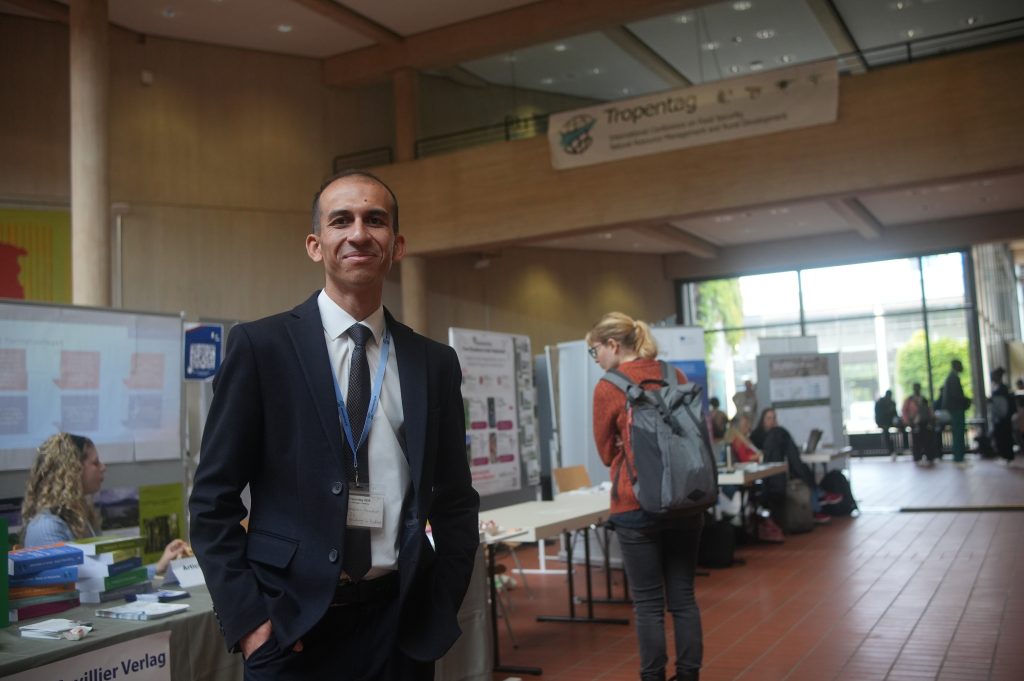
Shamsurrahman Hamdard at Tropentag 2026 (Photo: Ajit Masurkar)
When economic pressures hit from both sides
For farming households, economic shocks can create pressure at different points.
Higher food prices make it more expensive to feed a family, while lower crop prices can reduce the income households receive from farming. The analysis found that both types of economic pressure were associated with greater coping stress, lower dietary diversity and more severe hunger.
Environmental shocks added another layer of difficulty.
Droughts and floods were also associated with increased coping stress, reduced dietary diversity and greater hunger. For rural households whose livelihoods depend heavily on agriculture, environmental damage can affect much more than a single harvest. It can also influence income, food purchases and the ability to recover from future shocks.
Together, these pressures can create a difficult cycle: a shock affects production or income, households have fewer resources available for food, and families may then change what they eat or rely more heavily on coping strategies.
Not every shock affects households in the same way
The study also produced some less expected findings.
Cold temperatures and hail were associated with lower coping stress and hunger, as well as modest improvements in Food Consumption Scores. Rather than suggesting that these events are beneficial, Hamdard’s findings point to the importance of context when examining environmental shocks.
The effects of a shock can depend on where and how it occurs, as well as the characteristics and resources of the households exposed to it.
Household socioeconomic conditions also mattered. Higher income and secondary education were consistently associated with better food security outcomes, although the relationship with education was not identical across all indicators.
Strengthening resilience through income and education
For Hamdard, the findings point towards two important areas for strengthening household resilience: income and education.
Income stabilisation programmes could help rural households cope with sudden changes in food and agricultural markets. Expanding educational opportunities, particularly at the secondary level, could also contribute to stronger food security.
He also sees climate-smart agriculture and social protection as important parts of a broader response to the multiple pressures facing rural households.
The central message is that households should not be viewed as facing economic and environmental shocks in isolation. Understanding how different pressures overlap can help identify where support is most needed.
Learning beyond the presentation
For Hamdard, presenting at Tropentag was also an opportunity to improve his own research.
He was particularly interested in connecting with other researchers working on food security and attending sessions focused on food systems. Discussions with other participants gave him new ideas for strengthening his methodology and considering additional indicators for future research.
Rather than looking at food security through only a few measures, he is now considering how additional indicators could provide an even broader understanding of how households respond to shocks.
“From many researchers that I met, specifically those who are working in food security, I can improve my methodology,” he explained.
Understanding food insecurity as a connected problem
Economic and environmental shocks do not necessarily arrive one at a time. For rural households in Afghanistan, rising prices, falling agricultural returns and environmental stresses can overlap, placing additional pressure on already vulnerable livelihoods.
By examining these pressures together and looking at several dimensions of food security, Hamdard’s research highlights the complexity of household resilience.
And for him, Tropentag offered more than a place to present those findings. It provided an opportunity to exchange ideas, meet researchers working on similar questions and take new approaches back into his research.
At a conference built around food systems and resilient futures, that exchange may be just as important as the presentation itself.
Interested in the research? Read Hamdard’s full Tropentag 2026 abstract titled “The impact of economic and environmental shocks on household food security and sustainability in Afghanistan.”