Eric Smaling’s advice to young scientists: read Africa’s colonial history, because “their logic may not be your logic”
The soil scientist and former Dutch senator and MP, whose career took him from Wageningen to the tropics and into parliament, urges early-career researchers to look beyond their experiments and read the colonial history that still shapes Africa. From there, he reflects on science and politics, the nitrogen conflict, the EU levy on processed African chocolate, Africa’s future and the foundation he runs on the Kenyan coast.
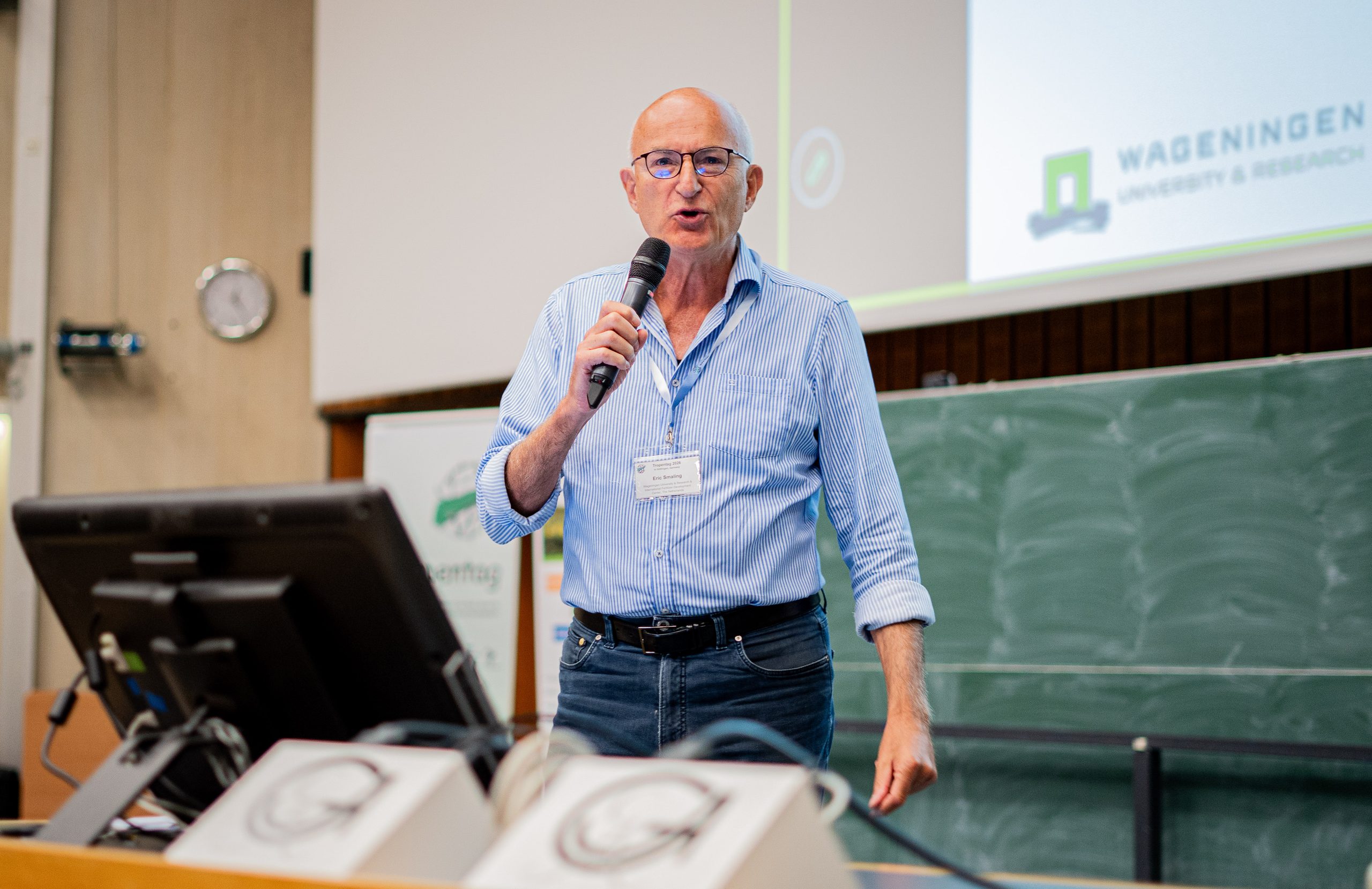
Eric Smaling speaking at Tropentag 2026 in Göttingen, Germany. Photo: Adesoji Adeyemi-Adejolu
Advice for young scientists: look beyond the experiment
For scientists at the start of their careers, often absorbed by a single experiment or case study, Prof. dr. ir.Eric Smaling has advice that reaches well beyond the lab: read history. He does not expect them to give up their focus. He recalled that during his own master’s and PhD he was “also more narrowly focused because I didn’t have all the experience”, with a thesis to finish and papers to publish, and acknowledged that “it makes a lot of sense that when you are still at MSc, PhD level, your focus is there”.
“But at the same time you should broaden your view, read as much as possible”, he added. He suggested reading “some books that really stand out for me”, starting with Thomas Pakenham’s The Scramble for Africa, which he described as “a big book, but it describes the whole colonial history of Africa”, and which in his view “opens so much your knowledge on how things came about”.
The reason, he explained, is that “understanding history helps a lot”. Africa’s 54 countries were “largely determined by colonial boundaries”, and knowing that past means “you know where they come from and you know why they differ and why some things take time to grow and develop”. Smaling pointed out that Western systems were imposed on what were, in some areas, “clan-based societies that have never known democratic systems that we have been imposing on them”, and concluded that history “helps you understand why their logic may not be your logic”.
History is only the starting point. He encourages young researchers to read about Latin America, Asia and Africa until they build “a kind of comparative picture”, to talk to knowledgeable people, and to use conferences to “meet some interesting people that can lift your level and broaden your horizon”.
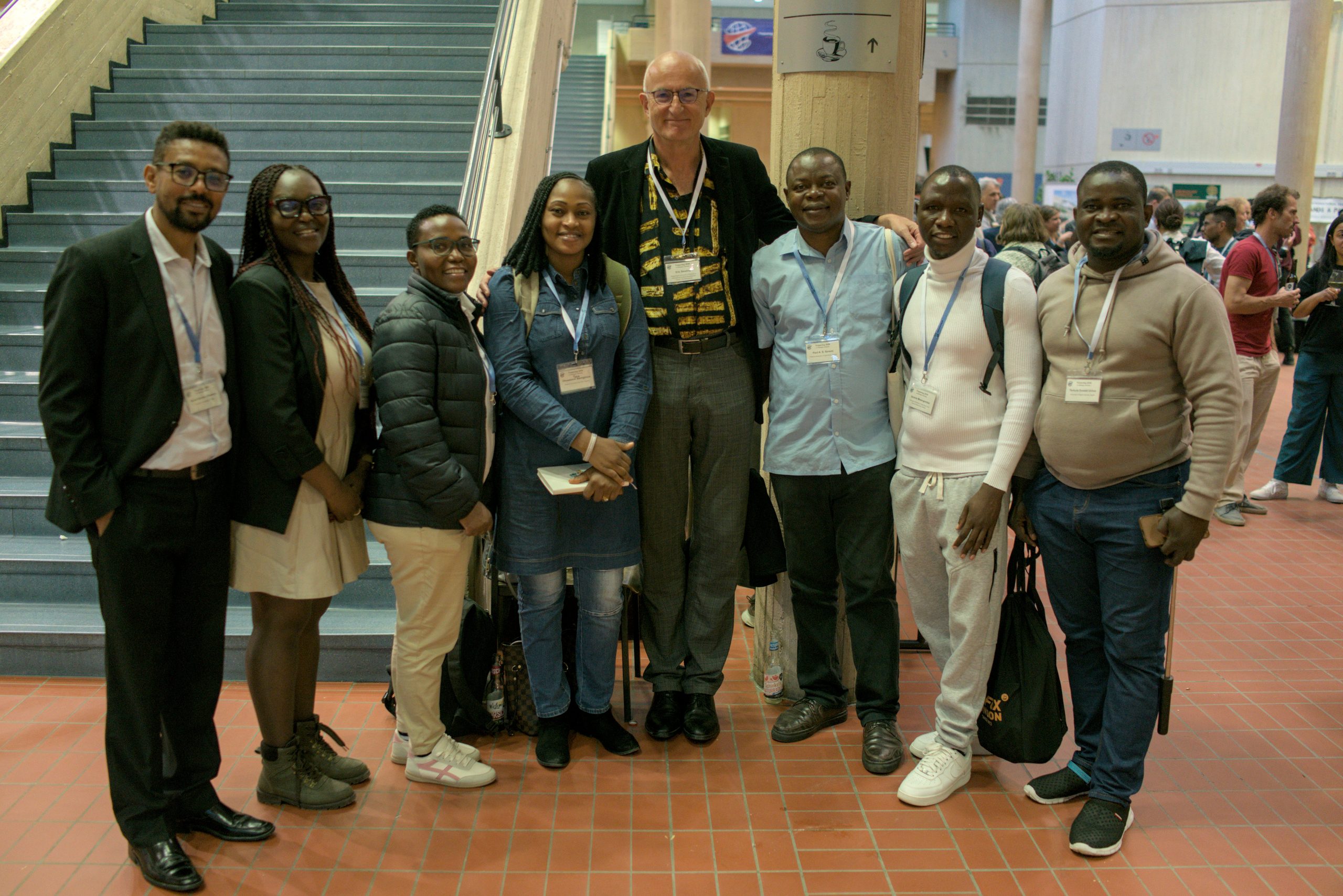
Smaling with participants from Namibia University of Science & Technology at Tropentag 2026. Photo: Julius Nickl
Who is Eric Smaling
His own career followed that wide path. Born in Amsterdam 69 years ago, he went to Wageningen after secondary school, a move he called “exceptional for somebody from Amsterdam”, leaving the city “to go and study in a village somewhere in the middle of the country”. He confessed that as a young man he “wasn’t so outspoken on which way I wanted to go”, and ended up in soil science. It was during his practical fieldwork in Kenya that he realised “this is really my cup of tea”.
That discovery launched a career “largely in the tropics, also largely in Africa”, focused on soil fertility management, with long periods in Indonesia, Kenya and West Africa and shorter ones in Asia and Latin America. Back in the Netherlands, he became professor of soil science and land evaluation at Wageningen in the late 1990s, and later moved to ITC at the University of Twente, a faculty specialised in geo-information science and remote sensing, where he supervised PhD students, taught at bachelor and master level and ran research programmes funded by Dutch sources, the EU and the Rockefeller Foundation. Between 2007 and 2017, as he put it, he “defected into politics for some time”, after years of being “always politically active, but not too active because of my regular visits to the tropics”. He represented the Socialist Party (SP) in the Dutch Senate from 2007 to 2013, and then in the House of Representatives until 2017.
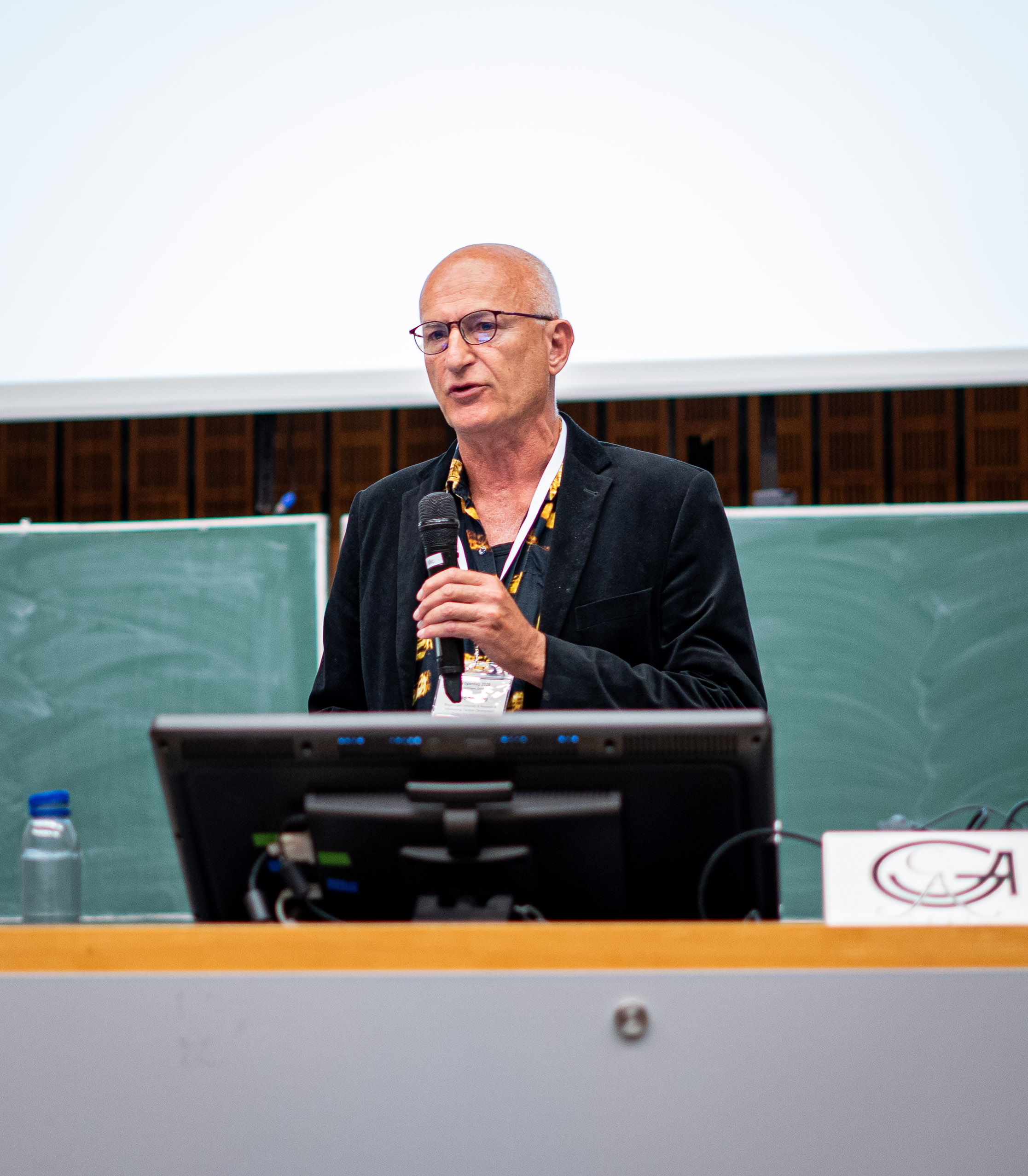
Smaling during his talk at Tropentag 2026. Photo: Adesoji Adeyemi-Adejolu
A scientist in the Dutch parliament
Smaling admitted he entered parliament as “a bit of a scientific nerd thinking that science can just easily be translated into policies”, and soon learned that “it doesn’t work like that”. Most politicians, he observed, are generalists who “know about many things. The main things”, while specialists tend to sit in the Senate, where members are older and have “a career in something that justifies their portfolio”. In the lower house an expert is an exception, and only once ministers realise “that you know a lot about agriculture or spatial planning or environment” do they start to listen, which requires building “a kind of rapport with them and with your colleagues”.
The extension of the port of Rotterdam showed him the limits of that influence, in an episode he illustrates with a soil map, one that the politician he was trying to persuade had never seen before. The Netherlands has a “nature compensation system”, he explained, under which “when something is developed that goes against nature, then somewhere else you have to compensate that”. To offset the port, the minister chose to convert farmland that sat “on one of the best agricultural soils that we have”, even though next to it lay “a peat area which is very unproductive”. Smaling urged her to use the peat instead, where “you’re not losing much” and “you can rebuild your nature there”, rather than “scoop all that fertile clay soil out”. According to him, it did not help, because “the process was already in an advanced stage and she was not ready to go back and rethink it”.
Sitting in opposition, he could not gather a majority behind a motion, so “I had to convince them on knowledge”. That approach paid off over time. “The longer I was there, the more I managed to get done”, he said, because colleagues “start also trusting you that you are talking on a fact-based mentality”.
He has no plans to return, since “I consider myself too old now”, but he still follows politics closely, including the general debate on the government’s plans that followed the recent opening of Parliament. The current prime minister, he recalled, “was a young boy when I was in Parliament”, working as an assistant to his own party. Smaling has no intention of offering unsolicited advice to the new generation: “they know I’m around. Let them fly.”
Dutch farmers and the nitrogen conflict
On the conflict between Dutch farmers and the government, Smaling spreads the blame. Over the past 20 to 25 years, he argued, agricultural policy has been “very whimsy”, changing direction again and again. Farmers own land and buildings and carry heavy debts, many of them with Rabobank, the country’s agricultural bank, and “if the policy changes all the time, it drives you completely crazy”.
He is just as critical of the farmers. He referred to allegations that they were behind “sabotage of the railway system in my country”, which he called “a kind of protest that is unacceptable”, and criticised “a kind of level of stubbornness” in resisting “what is just inevitable”: EU nitrogen legislation, “which has to be implemented in Holland as well”.
Farmers are not all alike, he noted, but the conservative wing seems dominant, judging by how their main umbrella organisation operates in politics, something he sees as “part of the process”. His proposal is for farmers to shift part of their role from entrepreneurs to “landscape developers and landscape stewards”, which “would solve part of the problem”. What still surprises him is that agreement never comes “in a bit of a benign way” and instead “always has to go with a lot of protest and anger and belittling parliament”. In his words, “it’s still hard nuts to crack”.
EU subsidies, imports and the chocolate levy
Asked about Europe’s role in world food trade and the entry of imported food, Smaling began by stating that “trade is fine and trade finds its way at the global level”. His objection lies with EU subsidies. The agricultural budget “is still large” and “used to be even larger”, and the per-hectare payment that farmers receive “is actually spoiling the economic system”, putting other regions at a disadvantage. He cited North African countries, which for a long time could not compete “with their olives against the Southern European countries”, and admitted that “those things, I’m not so much happy about”.
Tariffs on African imports go further. If Ghana and Ivory Coast want to export finished chocolate, he explained, “the EU puts a levy on it”, in order “to keep them just exporting raw materials, so that in European countries, we can add the value”. The Netherlands benefits directly, with “a large cocoa, coffee, tea sector from which the country makes a lot”. He also stressed that “Holland is really a very big exporting country”, although “part of it is just coming in and then going to Germany”, and still “we are an extremely successful country when it comes to agricultural export”, second only to the US, “which is just unimaginable” for such a small country.
The question of who adds value and who remains a supplier of raw materials is also at the heart of how Smaling sees Africa’s future.
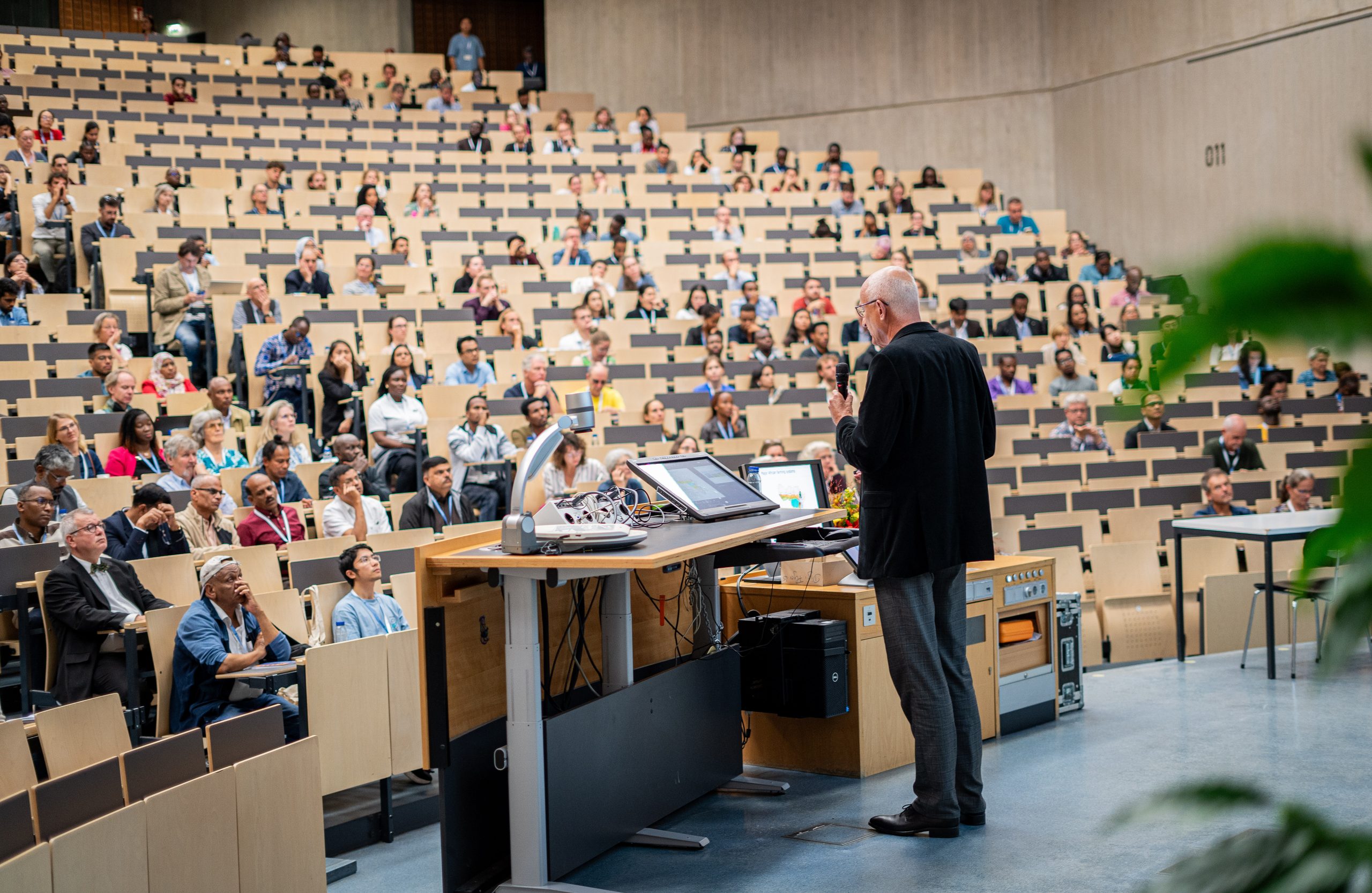
Smaling addresses the audience at Tropentag 2026 in Göttingen. Photo: Adesoji Adeyemi-Adejolu
The future of Africa: jobs, migration and value chains
He described “a bit of a dual feeling”. Returning to cities he had not visited for 20 or 25 years, and working in West Africa last year to manage a programme, he saw “changes that make me happy”: a more educated young population, “a vibrant middle class in many countries” and people able to take over leadership “in a modern way”. At the same time, he warned, the older generations still in power have been “susceptible a lot to the political benefits” of office, and “leaders have not always been really 100% for development of their own country”. In the countries he knows best, “poverty is still really, really bad”, with families unable to pay for school or keep enough food at home.
Youth unemployment is the other side of the coin. From Senegal to Kenya, he hears people in their twenties and early thirties complain about the lack of jobs, even those with higher education. “The jobs are not there. Everybody wants to go to Europe”, he said, linking the problem directly to migration. Smaling had expected that the jobs that moved from China to India would eventually reach Africa, as companies outsourced services, but that has not happened. “Agriculture cannot absorb all those young people”, he argued, “so you need manufacturing, service sector, industry, if possible, to absorb part of that labour force”.
In Europe, meanwhile, politics “is swinging very much to the right wing, which is largely due to this migration issue”. Right-wing politicians, he said, are “exaggerating, amplifying the problems that are caused by migrants”, and “many of the things they say are just not true, but people believe it”. In what he called “fake news days”, isolated incidents are “blown up to a national problem”, and Western Europe is “moving dangerously to the right, and even to the far right”.
His way forward starts in the cities. If urban employment grows, “then these people have to eat”, and agriculture “has a bright future if the urban population can pay for their products”. Beyond farming itself, he sees young people using digital skills, and perhaps AI, “to build new agricultural networks that are more efficient and effective” and “make value chains straight” with lower transaction costs, bringing the system closer to consumers. Africa already grows most of its own food, he noted, and cannot afford to import much more, “because where is the export that is compensating all that import?”
Why look to Kenya
For Smaling, Kenya shows that potential. “Kenyans are entrepreneurial people”, he said, always looking for opportunities and with a high academic standard, though he clarified that “I don’t know other countries as well as I know Kenya”. He singled out the Kikuyu community around Nairobi and Mount Kenya, “really looking for innovations, new ways to also to make money”, as fertile ground for sharing and developing ideas.
Nairobi, he recalled, “has grown so much since I was there in the 1980s”, and is now full of high-rise buildings, “not necessarily the best thing to do”, but it has become “a real hub in Africa” that attracts foreign companies and investment, with Addis Ababa following a similar path. “The cities grow”, he noted, and although many urban dwellers are still poor, “things also move. It’s not just gloom and doom”.
Demography strengthens the case. Within twenty years, he explained, “Africa will have the young people”, while other parts of the world age. The Netherlands already struggles to find workers for healthcare, construction and many other sectors, “we are running out of workers”, so an agreement between continents “would make a lot of sense”, with migrants also supporting their families and countries through remittances.
The foundation in Kilifi
Kenya is also personal. “Kenya is my second home. It’s my tropical cradle when I was 22”, he said. As a master’s student he spent ten months in Kilifi, a small town about 70 kilometres north of Mombasa, working with a field assistant a few years younger than him, with whom he stayed in touch after leaving. He returned to work in Kenya for a couple of years in the 1980s and kept coming back through Wageningen University.
A few years ago, at an age when you ask yourself “what are you still going to do?”, he met a man in Kilifi who ran an NGO teaching IT skills to rural youth. “We had a click”, Smaling recalled, and together they designed a programme for girls with good primary school results from poor families, orphans or girls with only a mother or an absent father, for whom “there’s no money to send these girls to high school, let alone to university”. He looked for sponsors in the Netherlands, while local communities helped find the girls, and invited two friends to set up a foundation, officially registered in the Netherlands so that supporters “know you are not bogus”. Today 35 girls are in high school or university, backed by Dutch, German and Belgian sponsors from the founders’ networks.
The foundation, named Rare Vrienden (Rare Friends), then added vocational training for young women in their early twenties with no prospects, who would otherwise be “at home and working in the kitchen”. In two-month courses, in groups of 20, they learn painting, tiling, carpentry and other trades. Since the programme began in 2024, in most groups “about half or even more of those girls have paid jobs”, he said, and some have started their own small company, which the foundation supports while “in principle they run their own show”. The women tell him that “getting money is one thing, but in my community, I’m somebody who has an ability who can do something”. For Smaling, “empowerment is even more important than making the money”.
In a couple of villages, women grow irrigated watermelon, aubergine, amaranthus and spinach after the main rainy season, and the produce sells “even before it has ripened, imagine”, he said. They manage their own account and a village savings and loan association, “a rather common model in Africa these days”.
The newest project turns coconuts into yoghurt. The coconut palms make the coast “really beautiful”, he noted, but bring farmers little money beyond palm wine, “which is just there for fun”. The foundation now works with women farmers who supply the coconuts and makes plant-based yoghurt from the meat, an alternative for people with lactose intolerance. The Kenya Bureau of Standards “has approved the process and the production unit”, he explained, and women are also the ones selling it.