The Three Hectares That Weren’t There
A ten-minute role play at Tropentag exposed a problem that no confidence interval can address: whether the person answering your question feels safe enough to tell you the truth.
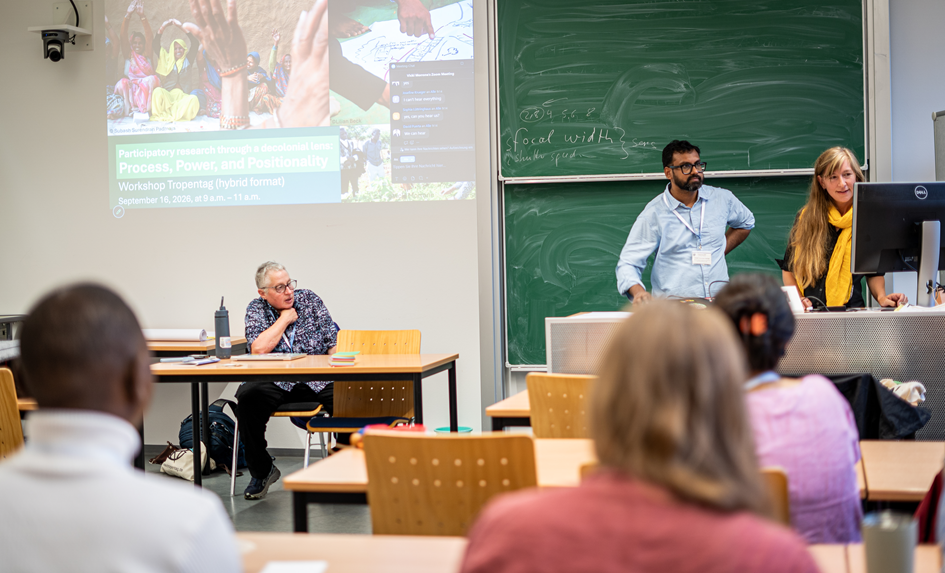
Photo credit: Adesoji Adeyemi-Adejolu
Room VG 1.105, Wednesday morning. Inside the workshop titled “Participatory Research through a Decolonial Lens: Process, Power, and Positionality,” workshop anchor Professor Vicki Morrone of Michigan State University watches as two co-facilitators (Lilian Beck and Subash Padmaja) perform a scripted role-play. Lilian acts as a rice farmer in Cambodia, while Padmaja acts as a water management expert who recently arrived in Cambodia. The rule of the short play is that whenever a facilitator raises a piece of paper, the audience hears what the character is thinking.
Padmaja begins: “Can I find a male farmer in your household?”
Lilian’s paper goes up. “Why does he want a man and not me? He never introduces himself. Name, age, village. Who is this? Maybe he is from the government?”
A question follows: How much land do you own?
Lilian’s fictional household owns some and rents some land. Nobody has measured the total land holdings precisely. Her paper goes up: “I will give him a number and get over with this.” Three hectares, she says. Padmaja writes it down.
He also asked about water. Yes, she says, there are problems, especially since the lake was privatised. Padmaja raises his paper: “My study makes total sense.” He thanks her and leaves. Finally: “One household done. Another 599 to go.”
The room laughs and then stops. Professor Vicki Morrone of Michigan State University reminds participants that the scenario is deliberately exaggerated. However, she adds, “But take it with a grain of salt. I have seen many forms of this.” The problem is that the three-hectare disclosure looks perfectly normal. No missing value or indication that the respondent has chosen a safe answer. So, the researcher leaves with a seemingly clean dataset. However, the farmer’s decision was shaped by trust and perceived risk. She suspected the stranger might be connected to the government and decided not to reveal the truth about her land. This is what we often call measurement error. The technical phrase can hide the human story behind it. It can tell us that a questionnaire was completed. But it may miss out on whether the respondent felt safe enough to answer honestly. This matters in participatory and decolonial research because a respondent’s social position can shape what they are willing to disclose.
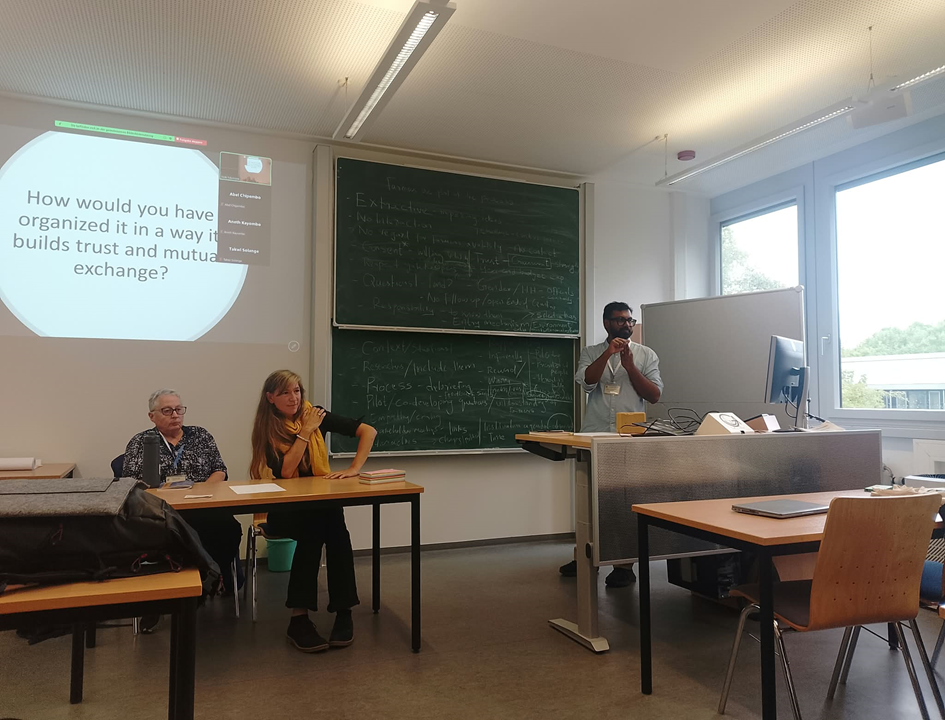
Photo credit: Chidi Emenike
At the 2026 Tropentag conference, experts are discussing indicators, models and pathways towards climate-resilient agricultural systems. These tools matter. But before any model, someone stood in a field and asked a stranger a question. Before there is a variable, there is a conversation. Perhaps, the first measurement challenge is not whether our data are complete. It is whether the respondent providing us the data felt safe enough to make it true.
Three hectares. A perfectly clean role, and a reminder that clean data can still hide a complicated reality.
Note: The farmer’s inner monologue was part of a scripted role-play.