Back to Basics: What Is a “Landscape” in Sustainability?
As part of the workshop “Towards Multifunctional Landscapes and Resilient Communities: The Process, Opportunities and Challenges”, Dr. James Reed shared his experience working with Integrated Landscape Approaches (ILAs) through the COLANDS (Collaborating to Operationalise Landscape Approaches and Nature, Development and Sustainability) project. Dr. Reed is senior scientist, Governance, Equity, and Wellbeing at Landscape Alliance.
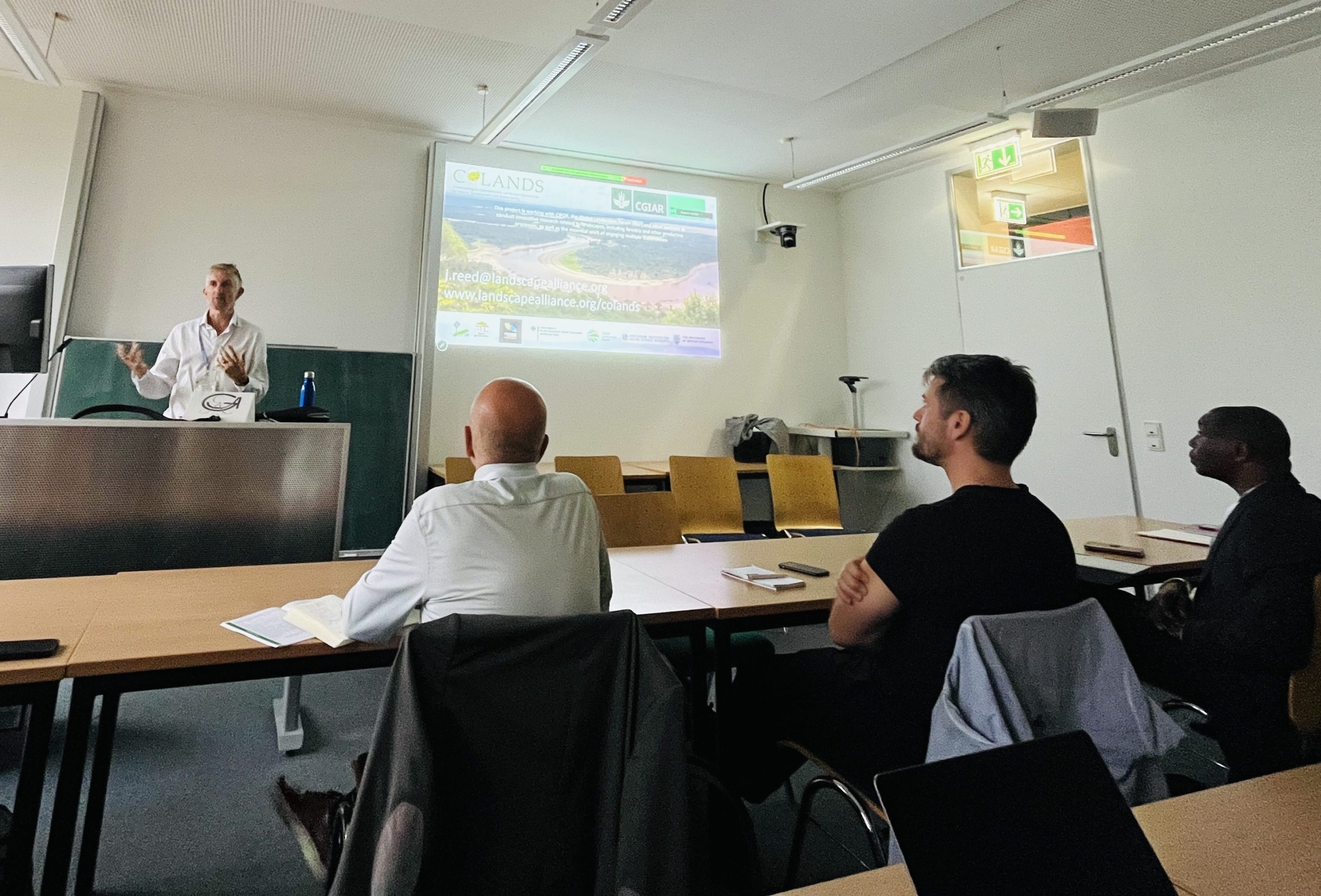
COLANDS works with partners, including the Center for International Forestry Research (CIFOR) and the Global Landscapes Forum (GLF), to conduct innovative research on landscapes, with a strong focus on engaging multiple stakeholders.
The talk began with a seemingly simple question: What is a “landscape”?
Despite years of research and work around landscapes, there is still no concretely established definition. This ambiguity leaves the landscape approach open to different interpretations. At the same time, it creates the potential for the concept to be misused or misrepresented. Greenwashing is an example of inappropriate interpretation of the landscape approach.
| Integrated landscape management is a participatory approach that promotes the coordinated management of land, water and natural resources across sectors and stakeholders within a defined landscape. It aims to meet multiple environmental, economic and social objectives by balancing competing land uses, managing trade-offs and creating synergies, so that ecosystems, livelihoods and development needs can be sustained over the short and long term. (Food and Agriculture Organization of the United Nations) |
Other challenges can arise from external factors, such as the termination of ongoing projects due to a lack of funding, or siloed thinking among stakeholders without transparent communication. These challenges can further contribute to imbalanced power dynamics.
This brings attention to the importance of integration. The more effectively relevant actors and factors are integrated, the better the meaningful outcome of the landscape approaches is.
But what do we actually mean by “integration”?
It starts at a very basic level, including the concepts around the land use and access to resources.
The presentation showed how this integration can look in practice in Ghana through multi-stakeholder workshops, focus groups, community surveys, and multiple discussions.
Some of the commonly shared priorities included weak governance and cooperation across scales, as well as agricultural expansion and the exploitation of natural resources such as mining.
The project also identified limited engagement from certain stakeholder groups, including the private sector, as well as low representation of pastoralists.
This raises an important question: How can we move beyond top-down approaches and create greater space for communities to shape landscape decisions?
The project team sought to address this by conducting community surveys to better understand local aspirations for landscape change. This helped identify micro-level opportunities which include raising awareness among authorities to support changes in the policy environment, improving accessibility to data, and working with donors to develop better financing structures.
From this practical experience, what became apparent was that scaling deeper is important; the process indicators that enable change are just as important as the outcomes themselves.
Takeaways
- Solutions need to address underlying structural and socio-political issues that influence social-ecological outcomes, rather than focusing only on the visible symptoms.
- Inclusive governance can help address multiple barriers to landscape transformation — from conflicting objectives and poor stakeholder coordination to issues such as corruption — while also helping to build trust and empathy among stakeholders.
- Deeper engagement is essential. Landscape approaches are not only about integrating different sectors and land uses; they are also about understanding who has a voice, who has access to resources, and just decisions.