Data Science Takes on Food System Challenges in Africa
Agricultural researchers are increasingly turning to data science to answer questions that are difficult to tackle through conventional research alone.
The University of Hohenheim, through the African German Centre for Sustainable and Resilient Food Systems and Applied Agricultural and Food Data Science (UKUDLA), organised a workshop on this topic at Tropentag 2026.
About 20 participants attended the September 16 workshop, which examined how tools including machine learning and other data-driven methods could be applied to food systems research in Africa.
The workshop focused on three questions: how data science can support food systems research, how researchers can communicate findings to different stakeholders, and how data science can strengthen research capacity.
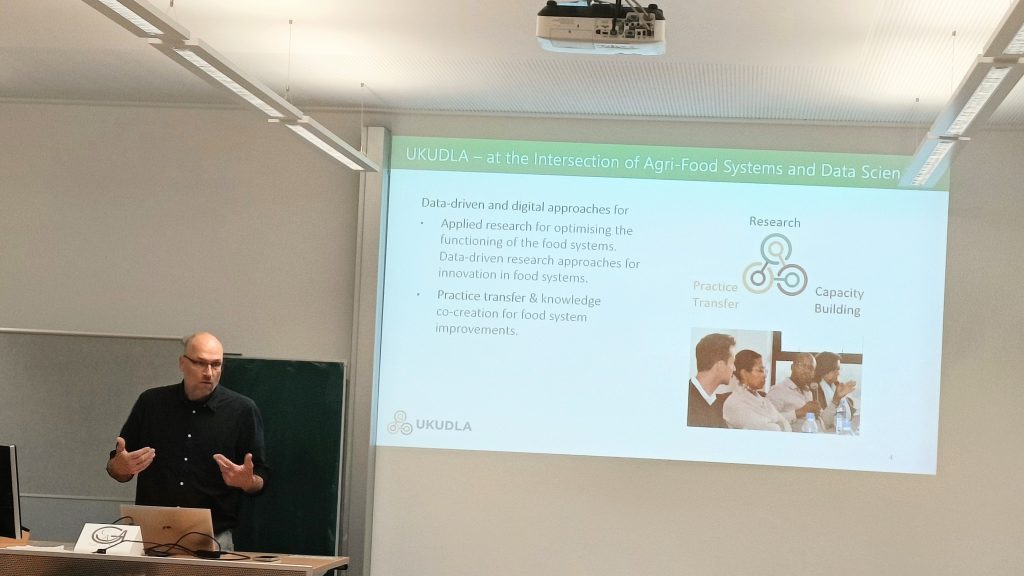
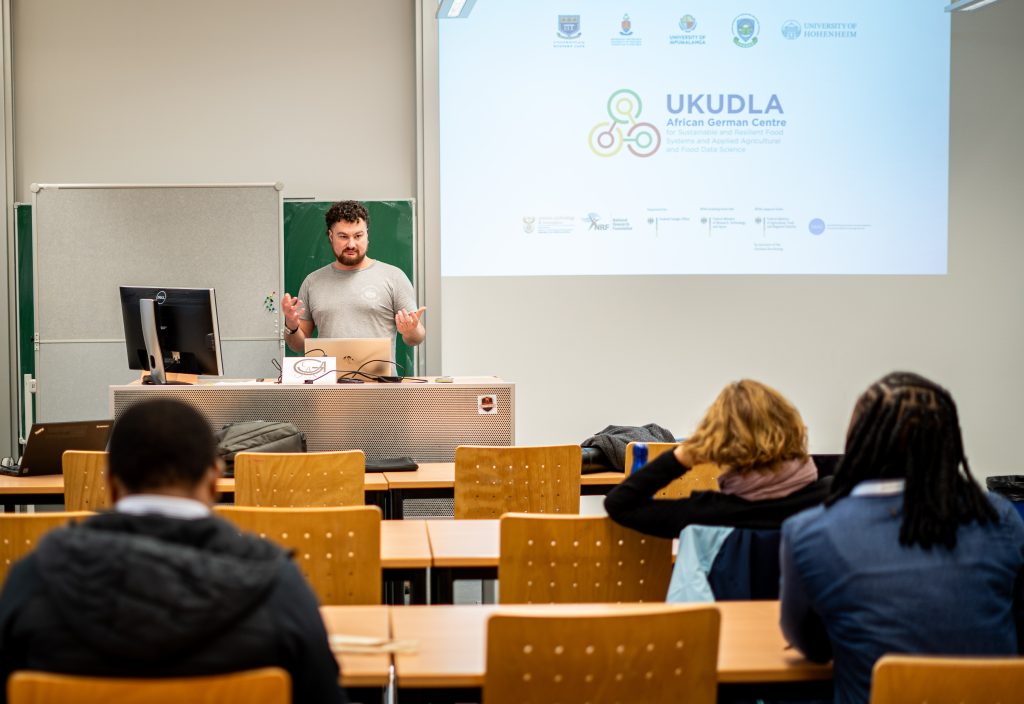
Marcus Giese leading the pre-conference workshop at Tropentag 2026 on the African German Centre for Sustainable and Resilient Food Systems and Applied Agricultural and Food Data Science (UKUDLA). (Photo: Swe Zin Moe)
From farm workers to machine learning
The projects presented during the workshop covered very different parts of the food system.
Federico Menna discusses his research on the Food Security Standard and the table grape value chain in South Africa. (Photo: Adesoji Adeyemi-Adejolu)
Federico Menna presented findings from his master’s research in South Africa, where he examined the applicability and potential adoption of the Food Security Standard in the table grape industry.
His research focused on farm workers but also considered the wider export value chain. During the study, Menna interviewed farm workers and connected with export companies, NGOs and unions representing workers.
The experience also gave him a closer look at how South Africa’s history continues to shape agricultural and food systems.
“It was very nice because South Africa is embedded in its history, in its apartheid history, and still now you see some reflection of this,” Menna said.
He encouraged students considering international research to look at opportunities offered through UKUDLA.
For another young researcher, the focus is less on individual workers and more on what large amounts of agricultural data can reveal.
Moritz Valentin Jejkal, a PhD researcher in the UKUDLA programme, is using machine learning and data science to investigate crop yields and the factors that constrain agricultural production.
His research looks at how environmental conditions, including soil and climate, interact with management and genetic factors.
The approach could allow researchers to examine agricultural questions across a wider geographical and data scale than would otherwise be possible, Jejkal said. In his case, the aim is to better understand constraints on production and identify ways to improve smallholder productivity in Southern Africa.
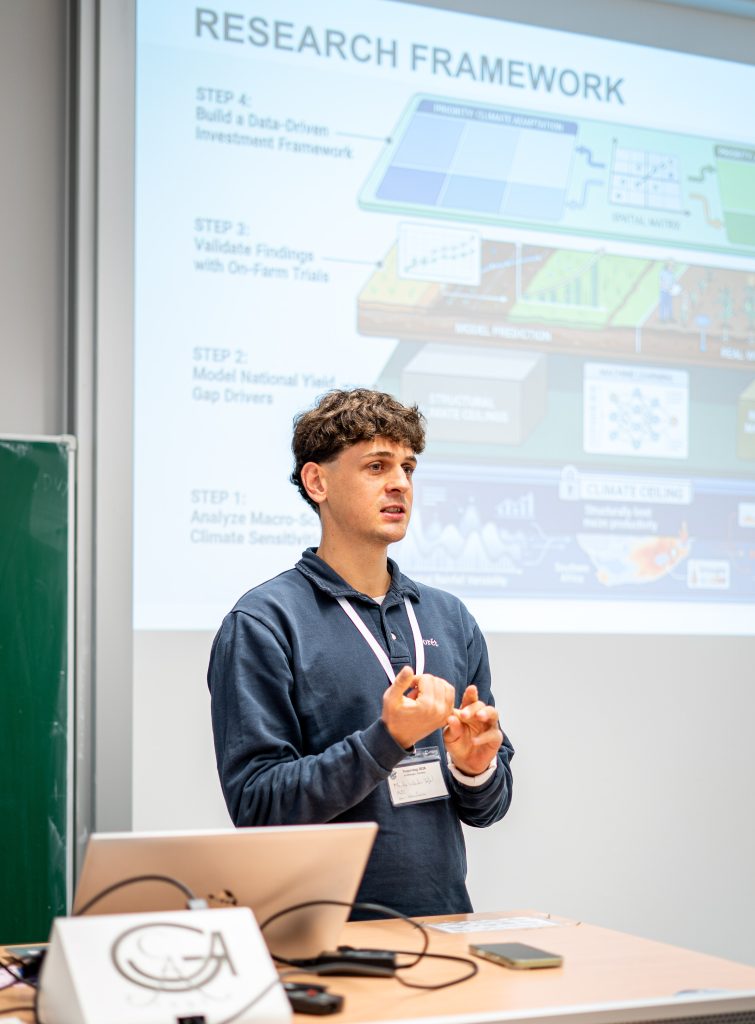
Moritz Valentin Jejkal presents his research on data science and machine learning in agricultural productivity in Southern Africa. (Photo: Adesoji Adeyemi-Adejolu)
A regional research network
UKUDLA links the University of Hohenheim with research partners in Southern Africa, including the University of the Western Cape, the University of Pretoria and the University of Mpumalanga in South Africa, as well as LUANAR University in Malawi.
The centre is also intended to build research capacity alongside its scientific work.
Marcus Giese, project manager of UKUDLA, said the programme is developing opportunities for researchers to spend time at the centre and work with its partners.
Among those opportunities will be a forthcoming call for postdoctoral positions for German postdocs. The positions are expected to begin next year and will involve two years of research at the centre in Southern Africa.
UKUDLA also offers exchange and scholarship opportunities within the programme.
Giese urged interested researchers to follow the programme for details of the upcoming call.
For a workshop centred on data, one of its clearest messages was about people: the technology may provide new ways to analyse food systems, but researchers still need the right skills, partnerships and opportunities to put those methods to use.
UKUDLA is part of the German Academic Exchange Service (DAAD) programme, “Fachzentren Afrika-Centres of African Excellence”. It is a joint synergy project between German and African institutions. On the German side, UKUDLA is funded by the DAAD, with funds from the Federal Foreign Office (AA), the Federal Ministry of Research, Technology and Space (BMFTR) and the Federal Ministry of Agriculture, Food and Regional Identity (BMLEH). On the South African side, the Department of Science, Technology and Innovation (DSTI) and the National Research Foundation (NRF) are involved.
More information is available at [ukudla-coe.ac.za].